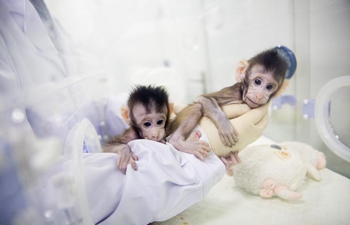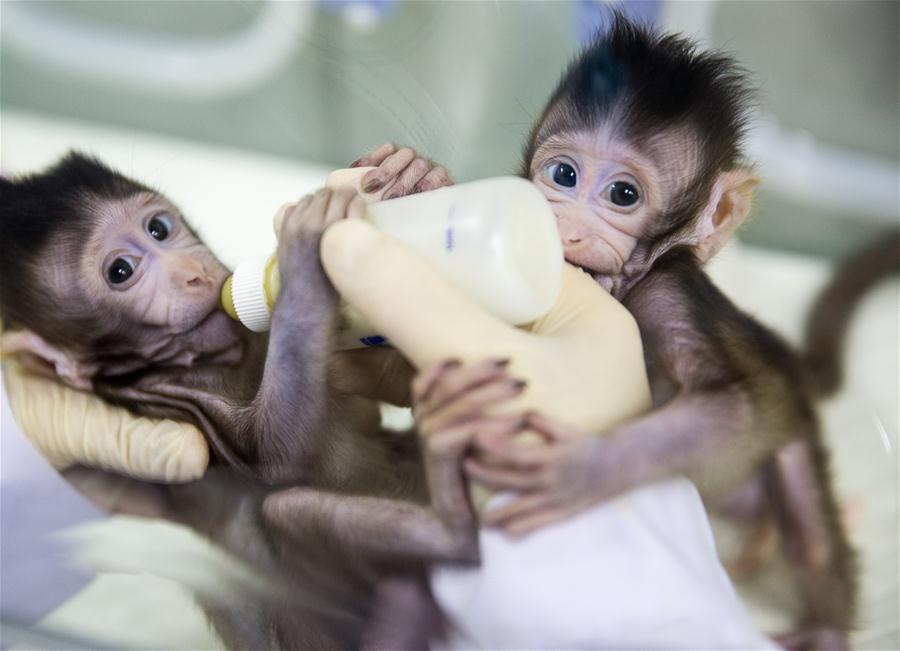
Two cloned macaques named Zhong Zhong and Hua Hua are fed at the non-human-primate research facility under the Chinese Academy of Sciences, Jan. 22, 2018. China on Thursday announced it successfully cloned world's first macaques from somatic cells by method that made Dolly. (Xinhua/Jin Liwang)
BEIJING, Jan. 27 (Xinhua) -- The first two cloned monkeys created by Chinese researchers have recently caught much spotlight on the international stage, as experts abroad praised the study as a technical advance with the potential of furthering human disease research.
"It's a landmark work," said Jun Wu, assistant professor at the University of Texas Southwestern Medical Center, who had participated in the creation of the first human-pig chimera embryos and the altering of the genes of a human embryo in the United States.
"Monkeys are the primates closest to humans and the biggest contribution of this work is to produce non-human primate models for human disease," noted the professor.
Echoing his perspective, Darren Griffin, professor of genetics at the University of Kent in Canterbury, England, called the study "very impressive technically."
Griffin pointed out that cloning primates has been proven as "much harder" than cloning other species like dogs, cats, pigs, horses and so on. "So to achieve that in primates has been quite a technical advance," he said.
The two genetically identical, long-tailed macaques, named Zhong Zhong and Hua Hua, were successfully created from somatic cells using the same technique behind Dolly the sheep, according to an article that Chinese researchers published on the scientific journal Cell.
"Such cloning allows the production of genetically uniform monkeys as animal models for basic research in primate biology and for studying human disease mechanisms and therapeutic treatments," the article said.
In this aspect, Griffin said that the production of such cloned animals could allow scientists to use "less animals" for their research.
"If you can do experiments on a set of cloned animals that all have the same genetic background you can be sure that any intervention that you give like a drug is the effective the drug itself not the natural variation of the population," he explained.
More specifically, Robert Desimone, Director of McGovern Institute of Brain Research at Massachusetts Institute of Technology in the U.S., labeled the study as "a significant advance" for disease research, as the cloning methods may be "particularly useful for combining several disease-related mutations in the same animal."
"I and many other neuroscientists believe that primate genetic models will be better for understanding human brain disorders for developing new treatments compared to mouse models, because the brains of monkeys are more similar to those of humans," Desimone elaborated.
Yet, Griffin warned that the first cloning of a non-human primate would raise ethical concerns, with critics arguing that this could possibly be "one step closer to human cloning."
"Careful consideration now needs to be given to the ethical framework under which such experiments can, and should, operate," he said. "Cautious optimism is my personal response to this study. The study itself is very impressive technically." Enditem
(Yang Shilong and Zhang Mengxi in New York, Lin Xiaochun and Zhou Zhou in Washington contributed to the story.)