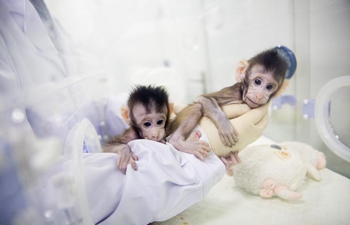
BEIJING, Jan. 26 (Xinhua) -- The successful cloning of two monkeys by Chinese researchers have excited the scientific community, with many calling it a great leap forward in biomedicine.
The two long-tailed macaques named Hua Hua and Zhong Zhong were the first primates cloned using the same techniques that produced Dolly the sheep in 1996.
Insoo Hyun of Case Western Reserves's School of Medicine said the successful cloning of monkeys is a remarkable breakthrough.
"People have been trying for the past 20 plus years to do this since the birth of Dolly sheep...But nobody has ever been able to produce live baby monkeys from this. So it's quite startling," the bioethicist told Canada's CTV NEWS in an interview.
Darren Griffin, a professor of genetics at the University of Kent, called the research "very impressive" from a technical standpoint.
Despite a series of ethical concerns, Griffin said the benefits of this approach, however, are clear.
"A primate model that can be generated with a known and uniform genetic background would undoubtedly be very useful in the study, understanding and ultimately treatment, of human diseases, especially those with a genetic element," he was quoted by the France-based news agency AFP as saying.
Jennifer Barfield, an assistant professor in biomedical sciences at Colorado State University, found the work significant, "particularly for primates, where success hasn't been that easy to come by," she told CNN.
Previously, the technique has only been used to clone animals like dogs, pigs and cats. Primates cloning has proven particularly difficult.
The process involves removing the nucleus from an egg cell and replacing it with another nucleus from differentiated body cells. Then the reconstructed eggs produced embryos, which were put into the wombs of surrogate female monkeys, producing a group of cloned monkeys with the same genetic background.
This success means China will be a pioneer in disease and brain science research by taking cloned macaques as animal models, said Muming Poo of the Chinese Academy of Sciences.
"We plan to produce more cloned monkeys designed for gene-related brain diseases, such as the Alzheimer's, Parkinson's disease and autism. It will give us an international edge in the research of primate brains," Poo added.