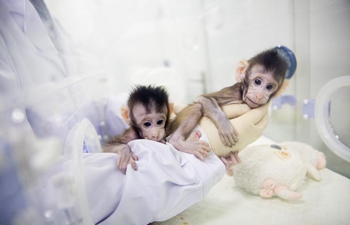
WASHINGTON, Jan. 26 (Xinhua) -- U.S. experts believe the successful cloning of two monkeys by Chinese scientists will help push disease research and treatment while hailing it as a technical advance.
"The cloning of the monkeys is a significant advance. Others had tried in the past and failed," said Robert Desimone, director of McGovern Institute for Brain Research at Massachusetts Institute of Technology (MIT) in Cambridge in Massachusetts state.
The two cloned macaques, named Zhong Zhong and Hua Hua, were produced at the non-human-primate research facility under the Chinese Academy of Sciences (CAS) at the end of 2017.
"One potential application is in the generation of primate genetic models for disease research," Desimone told Xinhua in a written interview.
"I and many other neuroscientists believe that primate genetic models will be better for understanding human brain disorders and for developing new treatments compared to mouse models, because the brains of monkeys are more similar to those of humans," he added.
Autism, schizophrenia, and neurodegenerative diseases such as Parkinson's disease, Huntington's disease, and Alzheimer's disease are all examples of brain disorders that "might see significant advances based on primate genetic models," he elaborated.
"Of course, outside of neuroscience, there are many other diseases where research would benefit from better genetic models," he added.
Jun Wu, an assistant professor at the University of Texas Southwestern Medical Center, described the successful cloning of monkeys as technically "a landmark work."
Cloning primates have proved much harder than other animals, including dogs, cats, pigs, horses, rats and mice since scientists successfully produced Dolly the cloned sheep in Scotland in July 1996.
"Monkeys are the primates closest to humans and the biggest contribution of this work is to produce non-human primate models for human diseases," said Wu, who was involved in the creation of the first human-pig chimera embryos for organ transplantation in the United States.