



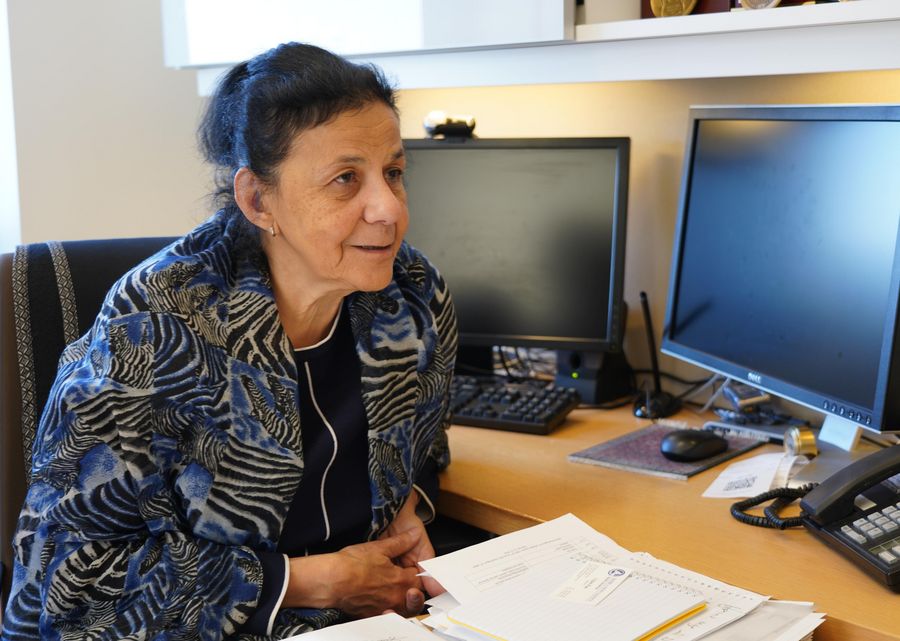
Wafaa El-Sadr, a leading U.S. public health expert, says China's efforts to combat the novel coronavirus (COVID-19) are encouraging in several aspects, while underscoring the importance of international cooperation and coordination in addressing such a major outbreak. (Xinhua/Zhang Mocheng)
Since the novel pathogen was first discovered in the central Chinese city of Wuhan in December, China has been using a host of resolute measures to curb the spread of the virus. Scientists identified the novel coronavirus rather quickly and medical institutions across the country were provided with kits that help facilitate diagnosis.
NEW YORK, Feb. 26 (Xinhua) -- China's efforts to combat the novel coronavirus (COVID-19) are encouraging in several aspects, a leading public health expert has said.
"It's very heartening to see how quickly Chinese scientists were able to identify the sequence of the virus" and published it rapidly thereafter, said Wafaa El-Sadr, director of the Global Health Initiative at Columbia University's Mailman School of Public Health.
These are "very useful to the global community to understand what this disease looks like," El-Sadr said in a recent interview with Xinhua.
The moves are valuable in terms of facilitating the development of tests to diagnose the virus disease as well as potential medication, said El-Sadr, a professor of epidemiology and medicine at Columbia University.
"Once you know the virus, you can start also thinking of developing vaccines," she added.
Clinical testing is essential to help bring people with symptoms quickly to the healthcare system, preventing potential transmissions, noted the researcher with expertise in various areas, including global health, hepatitis and infectious diseases.
Since the novel pathogen was first discovered in the central Chinese city of Wuhan in December, China has been using a host of resolute measures to curb the spread of the virus. Scientists identified the novel coronavirus rather quickly and medical institutions across the country were provided with kits that help facilitate diagnosis.
"China is going through a very difficult time. This is not an easy situation for any country to tackle ... we need to acknowledge this," said El-Sadr, while highlighting China's unparalleled ability to mobilize resources to swiftly develop the facilities to take care of a lot of sick people.
"That's enormous effort and that should be applauded, because it's very, very important to have sufficient places where sick people can get the care they need," she said.
El-Sadr also noted that it is important to try to have sufficient protective equipment for healthcare workers.
Meanwhile, she emphasized that frequent and accurate communication of information is critical in the battle against a major public health emergency like the COVID-19 outbreak.
"The more people are informed, the less likely they are to start imagining things and to start being fearful unnecessarily," she said.
Working with the general population through education information, such as circulating the knowledge about how to do self-identification and teaching simple things like frequent hand washing, is very helpful, said El-Sadr.
Underscoring the importance of international cooperation and coordination in addressing a major outbreak, the veteran expert said that "infectious diseases don't respect borders and we're all vulnerable" in face of epidemics.
She said that by strengthening collaboration on various fronts such as scientific research, China and the United States can contribute to the tackling of major global public health threats.
Assessing the ongoing COVID-19 battle, El-Sadr said it is still worrisome "that we haven't seen yet definitive evidence that we are on the down slope that we're getting to the point where the virus and the disease will be extinguishing itself."
Yet, she said she is "encouraged because of the level of awareness and the mobilization by communities and by scientists all around the world to try to overcome this." ■
