



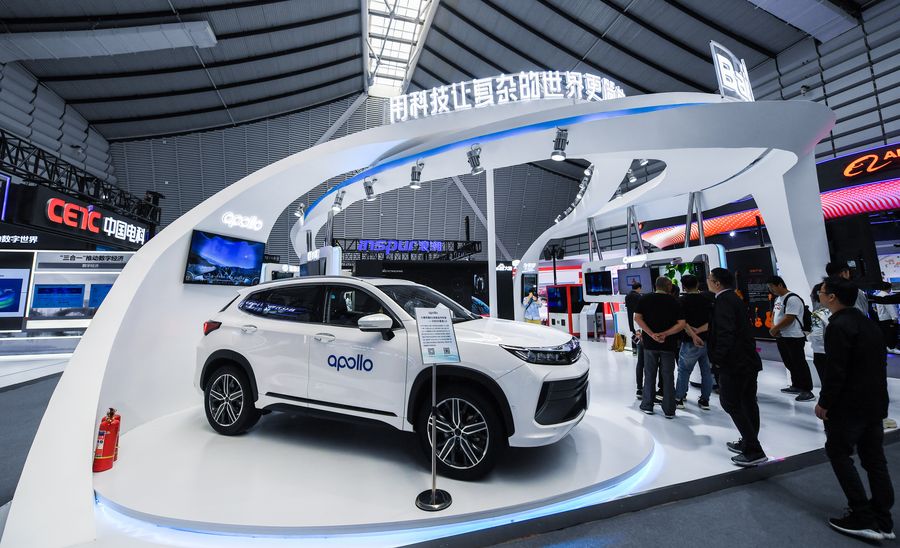
A driverless vehicle is displayed during the Light of Internet Expo in Wuzhen, east China's Zhejiang Province, Oct. 18, 2019. (Xinhua/Xu Yu)
An official document, issued by Chinese authorities, has outlined a roadmap for the country to scale production of driverless cars by 2025.
BEIJING, Feb. 24 (Xinhua) -- China has set 2025 as the target year for scale production of driverless cars of conditional automation, an official document showed.
The document, made public by the Ministry of Industry and Information Technology Monday, outlined the country's roadmap for developing automated vehicles, with specific tasks laid out to facilitate innovation in the sector.
By 2025, China will establish a basic ecosystem for driverless vehicles of Chinese standards, the document said, adding that the system should be continuously improved to build the country's strength in automated vehicles by 2050.
The country also aimed for market applications of self-driving cars of high automation under specific scenarios by 2025, the document said.
Depending on the level of automation, driverless vehicles are usually classified into different types. Conditional automation enables the vehicle to take control during part of a journey when certain operating conditions are met. In contrast, vehicles of high automation can handle more dynamic tasks but may still need driver intervention under certain circumstances.
To achieve its goal, the country will advance research and development of frontier technologies such as human-computer interaction and establish databases for evaluation and tests for automated vehicles, the document said.
The country will also carry out research on legal and ethical issues related to self-driving cars, and establish Chinese standards in various aspects, it said.
Tax incentives will be given to support startups and other enterprises in the sector, while foreign companies are encouraged to partner with Chinese firms in research and development of driverless vehicles, the document said. ■
