



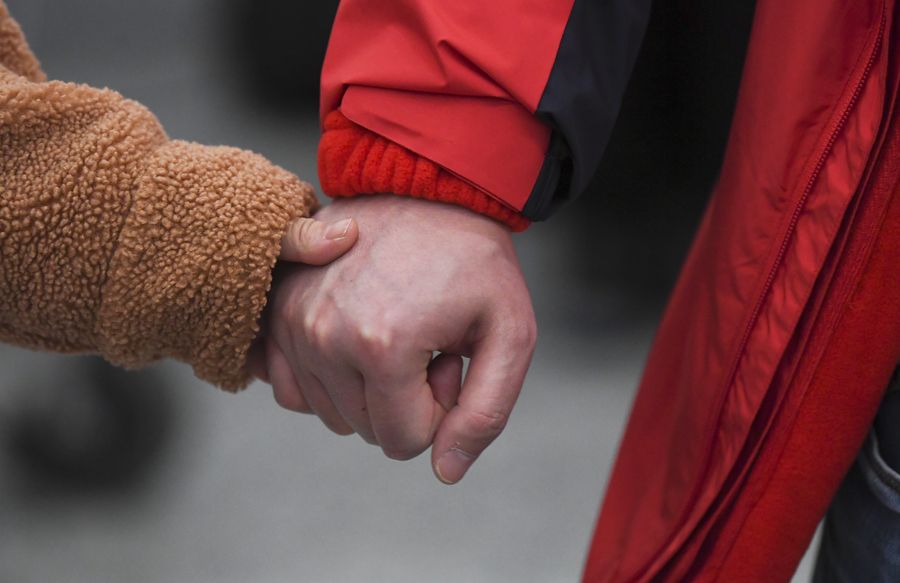
Jiang Lei (R), a doctor from the First Affiliated Hospital of Chongqing Medical University, holds his fiancee Gao Jia's hand at Chongqing Jiangbei International Airport in southwest China's Chongqing, Jan. 26, 2020. A team comprised of more than 130 medical workers from Chongqing left for Xiaogan City of Hubei Province on Sunday to aid the novel coronavirus control efforts there. (Xinhua/Wang Quanchao)
"At this critical moment for millions of Chinese who are suffering from the coronavirus, this headline triggers the extremely miserable memory for the Chinese since 1840 when the First Opium War broke out. I respect the First Amendment, but in a civilized society we should not tolerate this discriminatory opinion while humanity is under siege," Harry Zhang, associate professor with Old Dominion University in Virginia, said in a letter to the WSJ.
BEIJING, Feb. 21 (Xinhua) -- The Wall Street Journal (WSJ) is playing the victim after it published an article on China earlier this month with a racist headline, provoking a public outcry.
On Feb. 3, the WSJ published an article written by Professor Walter Russell Mead of Bard College about the impact of the novel coronavirus epidemic on the Chinese economy. The WSJ's editors at the opinion department wrote the headline, "China Is the Real Sick Man of Asia."
The derogatory reference to Chinese in the headline was soon met with criticism both at home and abroad. The WSJ has denied accusations of racism, saying "these days the 'sick man' phrase is used to describe many countries." However, such an argument was rejected by several U.S. mainstream media and experts.
Quoting Catherine Ceniza Choy, a professor of ethnic studies at the University of California, Berkeley, NBC News reported that the "racist association of Chinese bodies as disease carriers" has roots in white supremacist and nativist fears of Asian migration in the late 19th century.
The Washington Post reported that "Anti-Chinese racism always hinged on the belief that Asians harbor disease. In the 19th century, China was referred to as 'the sick man of Asia.'"
Harry Zhang, associate professor with Old Dominion University in Virginia, said in a letter to the WSJ that "I was horrified to read the headline 'China Is the Sick Man of Asia' on Walter Russell Mead's column. At this critical moment for millions of Chinese who are suffering from the coronavirus, this headline triggers the extremely miserable memory for the Chinese since 1840 when the First Opium War broke out. I respect the First Amendment, but in a civilized society we should not tolerate this discriminatory opinion while humanity is under siege."
In response to the public outcry, William Lewis, chief executive of Dow Jones and publisher of the WSJ, said in a statement that "Our opinion pages regularly publish articles with opinions that people disagree -- or agree -- with, and it was not our intention to cause offense with the headline on the piece."
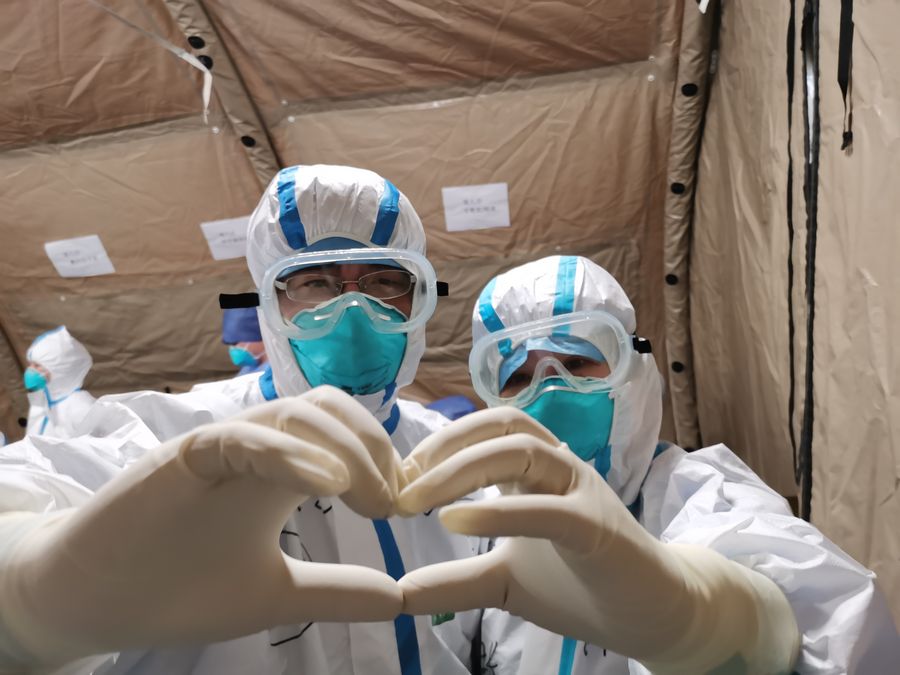
Mobile photo taken on Feb. 14, 2020 shows Gao Yongzhe (L) and Huang Wenli posing for a photo gesturing a heart-shaped sign at "Wuhan Livingroom" in Wuhan, central China's Hubei Province. Doctor Gao Yongzhe and nurse Huang Wenli are a couple working at the frontline against the novel coronavirus. (Photo by Gao Xiang/Xinhua)
In fact, the headline is so controversial that editors with the WSJ have voiced their opposition.
Quoting people with knowledge of the discussion within the WSJ, The New York Times reported that two inner meetings were held at the WSJ before Feb. 19 to discuss the headline, and "the headline was widely considered offensive within the newsroom."
"In one meeting last week, one of the people said, reporters expressed their anger over the headline to Mr. Murray, the editor," the Times reported.
Matt Murray, editor-in-chief of the WSJ, agreed that "the headline was bad," but that "his hands were tied because of the traditional separation between the news and editorial sides of the Journal," according to the Times.
"Mr. Lewis, the Dow Jones chief executive, participated in a more recent meeting. Newsroom employees again pushed to get top editors to change the headline," the Times added.
However, the WSJ still has the article with the racist headline on its website. ■
