 ?
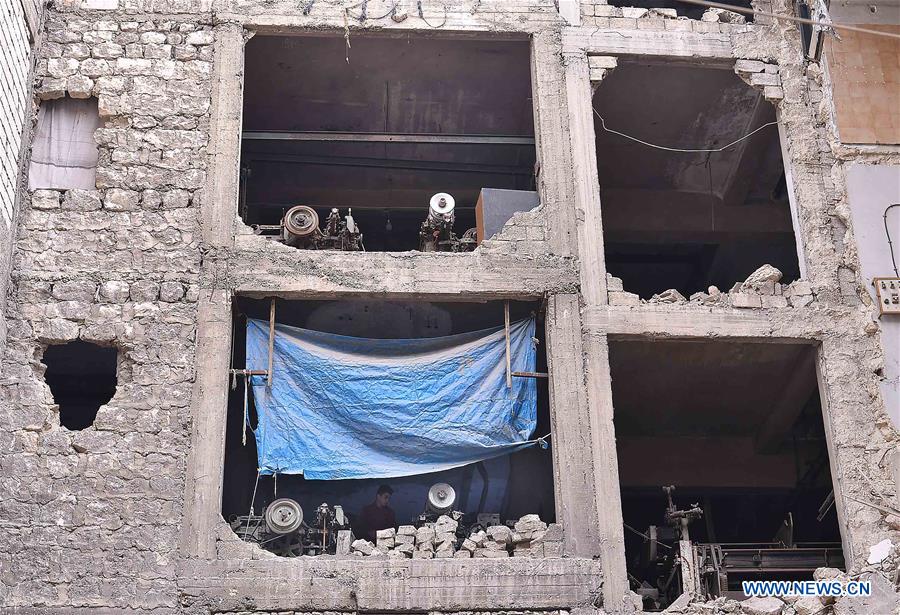
?Photo taken on Nov. 25, 2019 shows textile machines in a damaged building in the al-Qatarji industrial zone in Aleppo, Syria. Despite the destruction and shortage of electricity, the industrialists in the northern Syrian city of Aleppo have been devoted to the revival of the stagnating production in the city. (Photo by Ammar Safarjalani/Xinhua)
by Hummam Sheikh Ali
ALEPPO, Syria, Dec. 7 (Xinhua) -- Despite the destruction and shortage of electricity, the industrialists in the northern Syrian city of Aleppo have been devoted to the revival of the stagnating production in the city.
Long known as the industrial capital of Syria and with very hard workers, Aleppo has many industrial zones, most of which sustained huge damage in the war.
Following the Syrian army's recapture of Aleppo in December of 2016, the industrialists, who had previously abandoned their factories and businesses when the rebels took the city over, started returning to resume their work.
The size of destruction and lack of services were major barriers to the relaunch of production lines in Aleppo, but the people there have shown admirable determination to put the damaged city back on the right track.
In a recent visit to al-Qatarji Industrial Zone, one of the industrial areas in the previously rebel-held part in eastern Aleppo, columns of black smoke were seen rising from the factories, and loud noises were heard from the textile machines and the blacksmiths' shops.
Muhammad Mashqini, a young man who left his textile factory when the war broke out in Aleppo, came back to start his business from scratch.
He said despite the maintenance work he had done for his factory, it's nothing like what it used to be ahead of the war as there is some damage he couldn't repair.
"Before the war, this was a very well-equipped factory and now we face a lot of difficulties as this place is not fully fit to be operational and we have some damage that we cannot fix because of the high expense and the slow production," Mashqini told Xinhua.
The other major complaint is about the lack of electricity, which pushed the people to use electricity generators and pay a considerable amount of money for diesel fuel.
Saleh al-Mzayek, also a textile factory owner, told Xinhua that the lack of electricity is keeping him from running his factory in full swing.
"I fixed my machines because I wanted to start working. The electricity was supposed to be made available in 2017 but now we are in 2019 and still have no electricity," he lamented.
Al-Mzayek hoped the government will help address the electricity problem as these factories in Aleppo can bring in hard currency through exports.
"If we produce more, we will bring more hard currency. So we only wish the government will help us in the electricity problem," he noted.
His brother Abdul-Salam al-Mzayek, head of al-Qatarji Industrial Zone's committee, told Xinhua that about 70 percent of the industrialists have returned to the zone.
But "electricity is the main factor affecting the production and if we get electricity, our production will go back to 100 percent," he stressed.