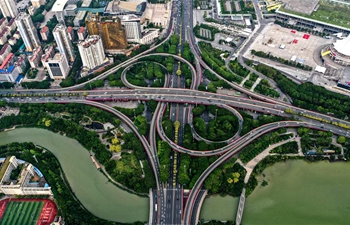
GUANGZHOU, Sept. 19 (Xinhua) -- Tourists who visit Guangzhou for the first time often take a ride on two sightseeing bus routes which travel along the city's central axes. While on board, they will learn how Guangzhou has developed over the past 70 years in eight languages.
It is not common for a metropolis like Guangzhou to have two axes. The 3-km ancient axis stretches from Yuexiu Mountain in the north and passes through Sun Yat-sen Memorial Hall, People's Park, Haizhu Square until it reaches the Pearl River in the south. It has remained as the center of Guangzhou and a witness of its historical changes over the past 2,000 years.
In 1968, the 27-storey Guangzhou Hotel, with a height of 86.51 meters, became the tallest building in the city at that time and a new landmark along the traditional central axis.
"The Yuexiu area has always been the city center of Guangzhou for more than 2,200 years," said Wang Huanqing, a local official. "It is the root and soul, as well as the driving force and experimental field for the ancient city."
As the pace of industrialization quickened after the founding of the People's Republic of China, the face of the axis has also changed. In the 1970s, the city's new tallest building, the 32-story Baiyun Hotel, was erected in the old town.
Urbanization at the time was increasing the rapid expansion of cities, with previously less-developed areas embracing opportunities to shine.
In 1987, Guangzhou welcomed the opening of the 6th National Games. Its main venue, Tianhe Sports Center, later became a key player to lead the transformation of the Tianhe new urban area. Now the area from Tianhe Road to Zhujiang New Town has turned into Tianhe CBD, a highly concentrated area for headquarters and businesses in high-end industries.
Covering 12 square kilometers, Tianhe CBD has attracted 201 world top 500 enterprises and created 62 "hundred million buildings" -- meaning the total annual revenue of companies from the building tops 100 million yuan (about 14 million U.S. dollars).
Now the new axis, with a length of 12 km, boasts the new height of the city. The 600-meter Canton Tower, the highest TV tower in China, gives visitors a birds-eye view of modern Guangzhou.
"The change of the axes is a reflection of how Guangzhou, a key player in the Guangdong-Hong Kong-Macao Greater Bay Area, made adjustments to its economic structure and strategic transformation," said Lin Daoping, Guangzhou's deputy mayor.
Over the past seven decades, Guangzhou's GDP has risen from 298 million yuan in 1949 to 2.28 trillion yuan in 2018, with an average annual growth rate of 13.78 percent.
Its economic structure is continuously being optimized, adhering to the "two-wheel drive" of the coordinated development of traditional industries and emerging industries, advanced manufacturing industry and modern service industry.
With the rise of the new axis, the traditional axis is also constantly radiating new vitality. Beijing Road pedestrian street has been listed as a new landmark of the "night economy" consumption in Guangzhou, with the daily average passenger flow reaching up to 200,000.
Renovation of Haizhu Square is also drawing to a close. The once boisterous wholesale market will bristle with office buildings and cultural and financial activities.
The well-known industrial avenue in Haizhu district, which housed more than 30 manufacturers in the 1990s, is being escalated into a science and technology innovation park, with the settlement of several leading tech names such as Tencent, Alibaba and Fosun.