



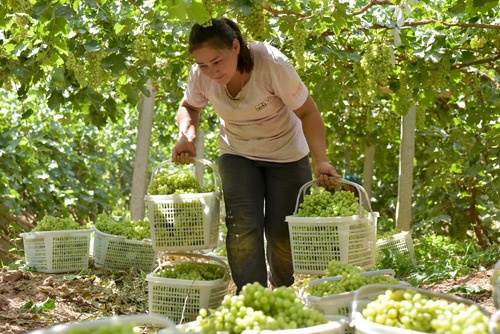
A farmer carries grapes in Shakan Village, Turpan City of northwest China's Xinjiang Uygur Autonomous Region, July 1, 2019. (Xinhua/Ding Lei)
What can we do with grape leaves? In Hotan Prefecture, northwest China's Xinjiang Uygur Autonomous Region, grape leaves are so valuable that can be sold at a higher price than grapes!
URUMQI, Sept. 10 (Xinhua) -- When thinking of profiting from grapes, the leaves are usually not a part of the equation. Previously only used to feed goats, grape leaves are now a major contributor to the rising incomes of villagers in Hotan Prefecture, northwest China's Xinjiang Uygur Autonomous Region.
Sitting on the edge of the Taklimakan Desert, Hotan Prefecture has plenty of sunlight, little rain and large temperature differences between day and night, making it a perfect area to grow fruit.
Gulnisahan Tohti, who has been growing grapes for more than two decades in the township of Langan, Yutian County, never would have imagined that grape leaves would be sold at a higher price than grapes.
The purchase price of grape leaves this year reached eight yuan (about 1.13 U.S. dollars) per kilo, while grapes fetched six yuan a kilo, she said.
"I never thought the leaves were so valuable," said Gulnisahan, who earned about 20,000 yuan from 5 mu (about 0.33 hectares) of grapes this year by selling both the grapes and leaves.
"I'll grow another 5 mu of grapes next year," she added.
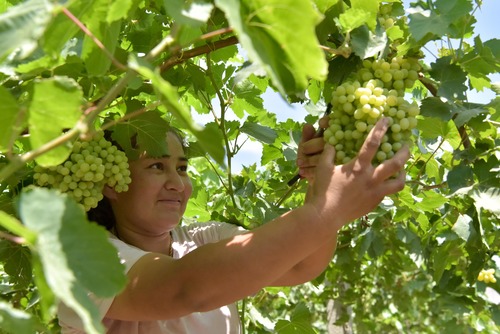
A farmer harvests grapes in Shakan Village, Turpan City of northwest China's Xinjiang Uygur Autonomous Region, July 1, 2019. (Xinhua/Ding Lei)
Not only Gulnisahan, but also many other grape farmers have made money by selling grape leaves to a local food processing firm that specializes in making rice-stuffed grape leaves, also known as dolmas.
Dolmas, which has a centuries-old history, is a popular appetizer in many countries, especially in Mediterranean nations.
Mutallip Anwar, general manager of the firm, saw the opportunity while studying in London years ago. Noticing that dolmas sold well in Western countries, he thought of the big vineyard in his hometown of Xinjiang.
After a series of field trips, Mutallip found leaves suitable for making dolmas in Yutian County and then started his business there. Now his products sell like hot cakes in Isreal, Turkey, Saudi Arabia, Australia and the United States.
The firm has also been a boon to local employment. Mutallip hired 240 seasonal workers and 42 long-term employees who earn a monthly salary of about 5,000 yuan.
Ezathan Mamet is one of the workers responsible for picking grape leaves. "I pick 20 kilos of leaves per day, earning about 160 yuan. That means I can make 5,000 to 6,000 yuan by doing this job for two to three months," she said.
"To complete this year's orders, I need 6,000 tonnes of leaves. However, there is still a 4,000-tonne shortfall even after all the leaves in Langan and nearby towns have been collected," Mutallip said.
More jobs are in the pipeline as he plans to set up another processing plant in Pishan County to ensure production.
Grape leaves are usually picked from May to September each year. The output of grape leaves per mu will generate 3,000 yuan for each household, according to Cui Yanwu, party secretary of Langan Township.
"The grapes can now be sold in three ways -- fresh grapes, leaves and raisins," said Cui, while adding that local villagers' lives have become better due to rising incomes from selling grape leaves.
