 ?
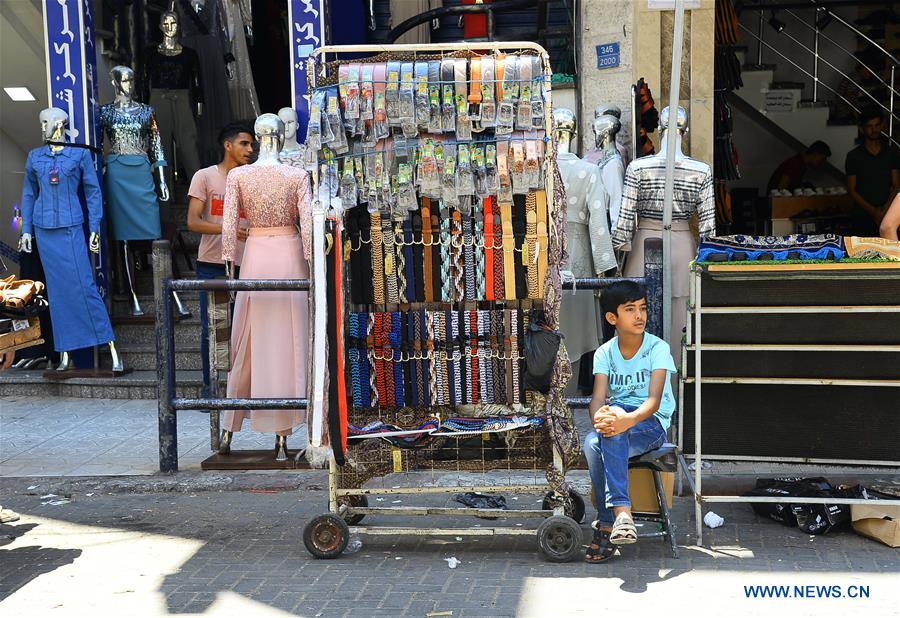
?A Palestinian vendor sells belts at a market ahead of the Eid al-Adha in Gaza City, on Aug. 6, 2019. Muslims in the Gaza Strip are preparing to celebrate Eid al-Adha, or the Festival of Sacrifice, amid hard living conditions caused by economic, political and social crises. Eid al-Adha is celebrated by Muslims worldwide in memory of Prophet Abraham's deed of nearly sacrificing his own son as ordered by God. (Str/Xinhua)
GAZA, Aug. 7 (Xinhua) -- Muslims in the Gaza Strip are preparing to celebrate Eid al-Adha, or the Festival of Sacrifice, amid hard living conditions caused by economic, political and social crises.
Eid al-Adha is celebrated by Muslims worldwide in memory of Prophet Abraham's deed of nearly sacrificing his own son as ordered by God.
Although the holiday is approaching, Gaza's markets lack the typical decorations associated with the feast, and despite that the markets are packed with goods, most customers don't have the means to buy even the most basic products, including bread, rice and meat.
Al-Zawia market is considered as the biggest and most crowded one in Gaza. But a large number of customers flocking there on a daily basis only do some window shopping.
"I see the goods in the market, but I cannot buy anything from the shops because of the high costs and I do not have the money," Halima al-Shaikh, a local resident, told Xinhua while she was buying a dress from a street vendor.
Halima doesn't believe that the enclave will see better days, pinning the blame on the politicians and the ongoing rift between them.
"In the past, women used to spend a week preparing for the Eid. Now, however, there is no more festivity. Days seem to be mundane," she said.
Another customer, a mother of six, said that she has stopped celebrating the Eid since 2007. "My children are looking forward to the holiday but I cannot bring them what they want, which ruins the holiday spirit."
In a corner of the market, a number of women surrounded 24-year-old shoemaker Ahmed Abu Nowfal who is repairing old boots of his clients.
Nowfal told Xinhua that he cannot buy new clothes and shoes for his two little sons.
"Some of my clients ask me to change the color of their kids' shoes to be able to tell them that they bought them something new," said Ahmed Abu Nowfal, adding that he cannot buy new garments for his sons.
"I have 10 Shekels (2.87 U.S. dollars), so instead of spending more than 200 shekels (57.5 U.S. dollars) on new pieces of clothes, I prefer to repair shoes, bags and clothes to save some money," said Suhaila Mohammed, while she was waiting for the shoemaker to finish repairing her shoes.
Traditionally, buying new clothes for children and sweets to serve visiting relatives is a regular habit to mark this occasion.
These seasonal occasions revive the purchasing power in the markets, which is considered as a good chance for the traders to earn more money.
But the situation is different for Mohammed Aljamal, who is looking at his goods that showed on a small stall selling in front of his big shop in order to attract clients who prefer to buy from the street venders.
"The economic situation is very difficult," he said, adding that the clients prefer to buy the used and old goods that affected negatively on their trading.
Israel imposed a tight blockade on the Gaza Strip since 2007, right after the Islamic Hamas movement ruled the enclave after rounds of fighting with the loyal forces of the Palestinian Authority.
Since then, the economy in the Gaza Strip has been deteriorating with a hard living conditions for its people.