 ?
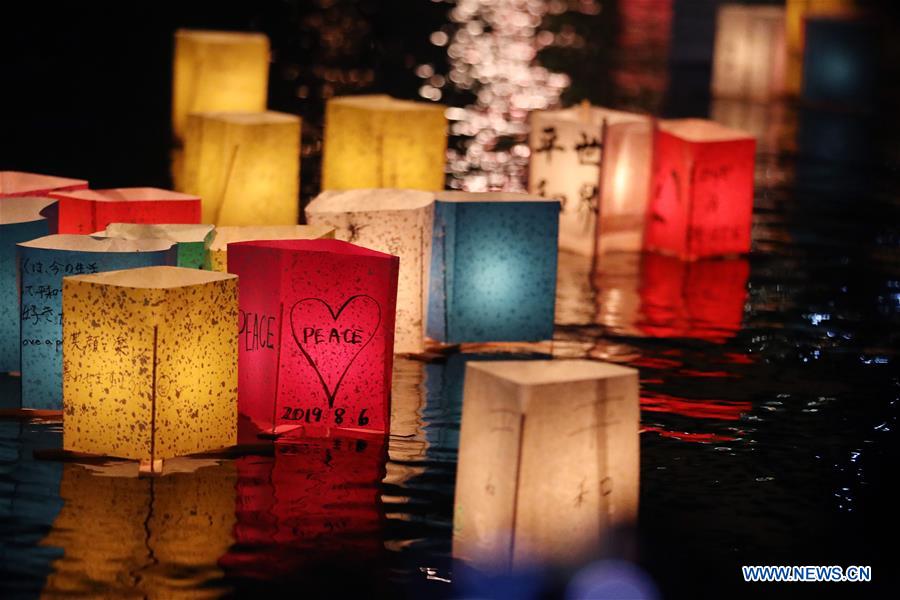
?Paper lanterns float in the river at the Peace Memorial Park in Hiroshima, Japan, Aug. 6, 2019. Hiroshima, the Japanese city hit by a U.S. atomic bomb at the end of the World War II, marked the 74th anniversary of the bombing on Tuesday. (Xinhua/Du Xiaoyi)
HIROSHIMA, Japan, Aug. 6 (Xinhua) -- Hiroshima, the Japanese city hit by a U.S. atomic bomb at the end of the World War II, marked the 74th anniversary of the bombing on Tuesday.
A memorial ceremony held at the Peace Memorial Park near Ground Zero was attended by about 50,000 audiences, including representatives from about 90 countries and regions.
Heavy rain started to pour down when the ceremony began at 8:00 a.m. local time in solemn music.
Representatives of the bereaved families, along with representatives of the atomic bomb survivors and foreign guests, dedicated flowers to the deceased.
A flock of doves representing peace were released during the ceremony.
Japanese Prime Minister Shinzo Abe delivered a speech at the ceremony, stressing the importance of continuing efforts to realize "a world free of nuclear weapons."
As the only country that has experienced atomic bombings in war, Japan's duty to eliminate nuclear weapons remains unchanged even in the Reiwa era, Abe said.
Japan is determined to serve tenaciously as a mediator between nuclear weapon states and non-nuclear weapon states and take the lead in making such efforts in the international community, he said.
Japan will also continue to promote policies considerate of "hibakusha," namely atomic bomb survivors in Japan, he added.
A message from UN Secretary-General Antonio Guterres was also conveyed during the ceremony.
"We must recall the core message that the hibakusha have travelled the world to spread: the only guarantee against the use of nuclear weapons is the total elimination of nuclear weapons," Guterres said in the message.
The ceremony ended with some children giving an affectionate recital of their commitment to peace and a chorus of Hiroshima Peace Song, receiving enduring applause from the audience.
A uranium-core atomic bomb named "Little Boy" dropped onto Hiroshima in western Japan by a U.S. bomber, exploded above the city at 8:15 a.m. local time on Aug. 6, 1945, killing an estimated 140,000 people by the end of the same year.
Nagasaki was also hit by an atomic bomb on Aug. 9, 1945, prompting Japan's surrender and the end of World War II.
While Japan inwardly looks at the tragedies it had experienced at the end of World War II, historians and political minds of the international community have encouraged Japan to come to see themselves not as merely victims of the atomic bombings but also as the perpetrators who led to these tragic incidents to happen in the first place.
Japan brutally occupied many parts of Asia before and during World War II, causing untold suffering and death to hundreds of thousands of innocent victims.
Undoubtedly, the events that took place in Hiroshima and Nagasaki were tragic, but there were numerous more heinous incidents carried out by the Japanese army, that until this day, have received far less coverage in educational textbooks, or in globally televised memorial services.