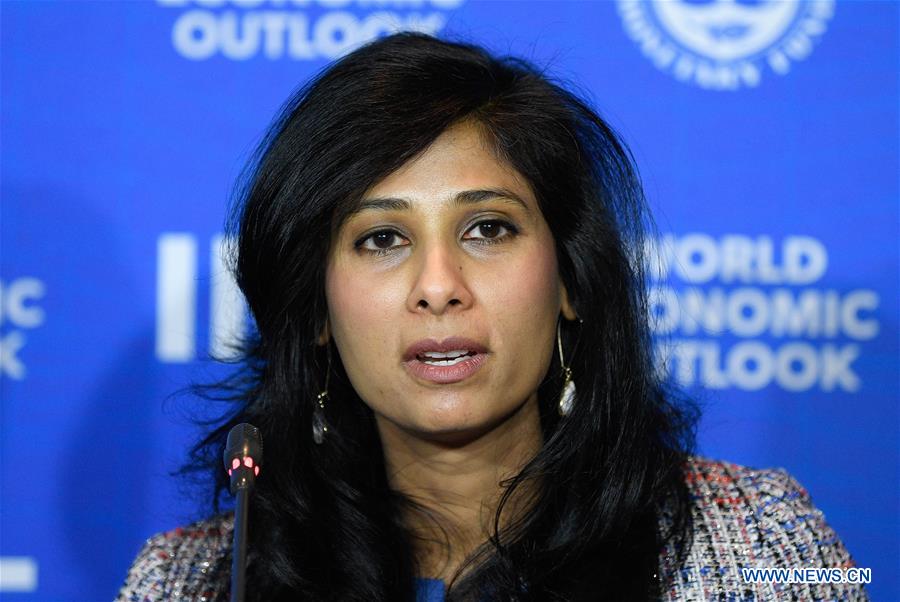
Gita Gopinath, IMF chief economist, speaks during a press conference in Santiago, Chile, July 23, 2019. The International Monetary Fund (IMF) lowered its global growth forecast to 3.2 percent in 2019, according to a report released here on Tuesday. (Xinhua/Jorge Villegas)
SANTIAGO, July 23 (Xinhua) -- The International Monetary Fund (IMF) lowered its global growth forecast to 3.2 percent in 2019, according to a report released here on Tuesday.
In April, the agency forecast a 3.3-percent expansion in global gross domestic product (GDP), but slow growth in the first half of the year, trade and technology disputes, and uncertainty regarding Britain's withdrawal from the European Union led to the downward adjustment.
The IMF's most recent World Economic Outlook report also downgraded the forecast for 2020, from 3.6 percent to 3.5 percent.
A breakdown of countries showed growth results were positive for several developed economies, though weaker than expected for emerging markets and developing countries.
Emerging markets and developing countries are expected to see a 4.1-percent growth in 2019 and 4.7 percent in 2020, a 0.3-percent and 0.1-percent reduction, respectively, compared to April, IMF chief economist Gita Gopinath told reporters here.
The downgrades were blamed on moderate investment and demand for goods, as households and businesses limit long-term spending, slowing capital flows, especially in the manufacturing sector.
The IMF called for strengthening fiscal policies to stabilize and spur economic recovery through structural reforms that guarantee sustained growth over the medium term.
The agency also urged greater multilateralism to strengthen the foundations for global growth.
To grow, the global economy needs less trade tensions and the rapid resolution of pending trade agreements, including between Britain and the European Union, as well as the ratification of the new North American Free Trade Agreement by Canada and the United States. Mexico's legislature has already approved the deal.
Governments should not use tariffs as a way to balance their bilateral trade exchange, the agency said.