




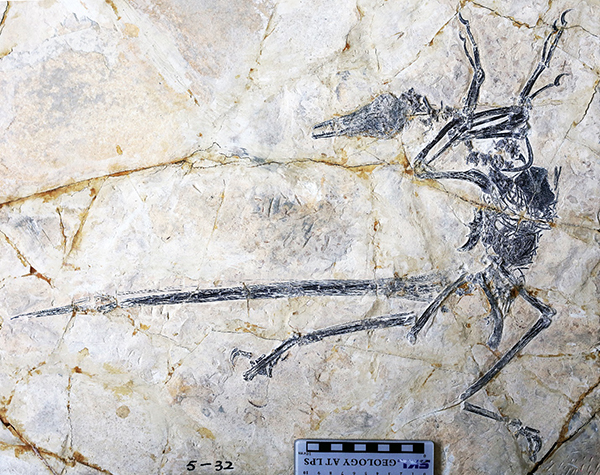
Photo shows the fossil specimen of the Microraptor. Photo provided by the Institute of Vertebrate Paleontology and Paleoanthropology under the Chinese Academy of Sciences
BEIJING, July 16 (Xinhua) -- Chinese scientists have identified a new species of lizard from a fossil specimen of a Microraptor, a flying dinosaur living in the early Cretaceous period.
Microraptor is one of the world's smallest carnivorous dinosaurs. The fossil specimen of the Microraptor was found in Liaoning Province in 2005.
Scientists from the Institute of Vertebrate Paleontology and Paleoanthropology under the Chinese Academy of Sciences have found the remains of a nearly complete lizard preserved in the Microraptor's stomach.
The lizard is distinguished from previously recognized early Cretaceous species based on its unusual teeth and bones.
According to Zou Jingmei, one of the researchers, this dinosaur is now known to have fed on mammals, birds, fish and lizards. This is the fourth documented occurrence of a Microraptor with preserved stomach contents.
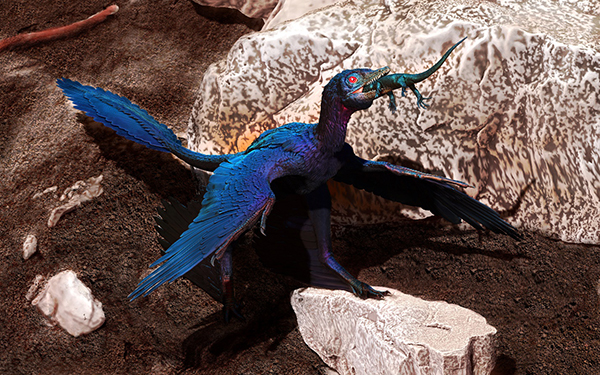
Photo shows the reconstructed scene of the microraptor swallowing the lizard. Photo provided by the Institute of Vertebrate Paleontology and Paleoanthropology under the Chinese Academy of Sciences
The lizard is nearly complete and articulated, showing that it was swallowed whole and head first and indicating that Microraptor had a primitive digestive system and fed in a manner similar to living carnivorous birds and lizards.
In contrast with fecal fossils and bone fossils, stomach content fossils provide direct evidence of feeding habits. The relationship between these predators and prey helps us better understand the entire ecosystem, according to Zou.
The research was published in the journal Current Biology.
