 ?
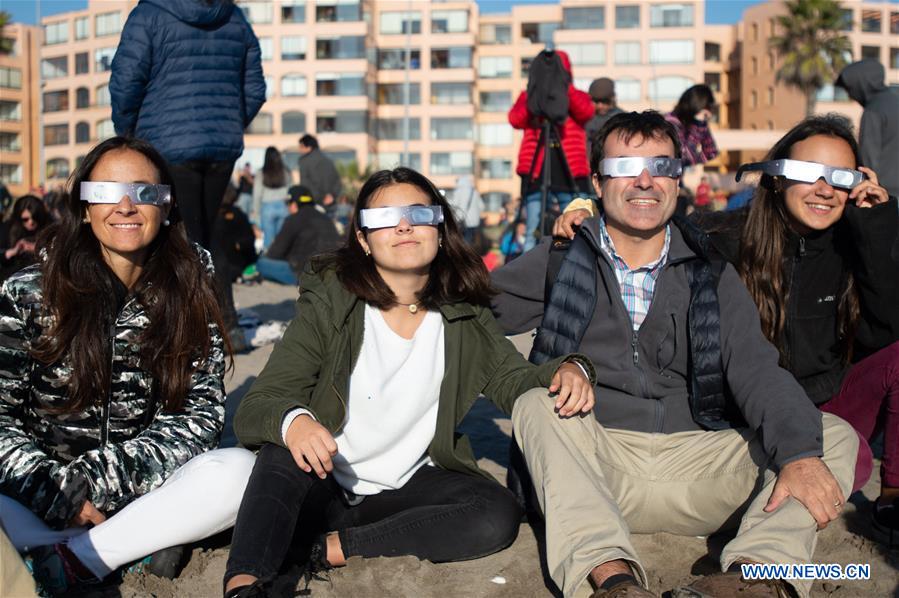
?People watch the solar eclipse in La Serena, central Chile, July 2, 2019. A total solar eclipse occurred in La Serena on Tuesday. (Xinhua/Jorge Villegas)
LA SERENA, Chile, July 3 (Xinhua) -- A solar eclipse threw a number of cities in the Chilean region of Coquimbo into darkness on Tuesday for more than two minutes.
Thousands of local residents, tourists, and scientists came together on the beaches of Coquimbo, which is located around 470 km to the north of the capital of Santiago, to see the eclipse.
In the area of La Serena, the maximum eclipse lasted two minutes and 15 seconds, while in La Higuera, it lasted two minutes and 36 seconds.
The moment of total darkness was marked by a drastic drop in temperature and the erratic flight of birds. The event elicited both cheers and tears from spectators, who wore special glasses to shelter their eyes from the sun's harmful rays.
Local student Simon Salgado told Xinhua that it was the most beautiful natural phenomenon he has seen.
"How day becomes night. How the temperature drops. It's difficult to describe in words," he said.
Fellow spectator Bastian Milategua said that his experience of the natural phenomenon was that it was "from another planet, another dimension."
"My heart started to race at 1,000 beats, and when I saw the complete ring, I jumped backwards. It was so exciting. What I felt is indescribable," he said.
At the La Serena Stadium, a special talk on the eclipse was given by Jose Maza, recipient of Chile's National Prize for Exact Sciences.
Maza, who is also a professor at the University of Chile, explained to Xinhua the extreme scientific importance of observing the sun's corona, which can only be seen during a total eclipse.
"The sun is a ball of gas... when it's very dense, you can see light coming out, but there is a lot of sun behind, which is called the sun's corona, so the corona stays visible when the moon is blocking the sun," he said.
The event was a great scientific opportunity, he said, as the Chilean observatories of Cerro Pachon, Cerro Tololo, and La Silla were right in line with the eclipse.
Maza said that this was also a big opportunity for the region's young people, as this phenomenon had not been seen in the area for more than 400 years.
Earlier in the day, Chilean President Sebastian Pinera visited La Silla observatory in the city of La Higuera in Coquimbo and said, "today, Chile is the world capital in the area of astronomy."
"We are the eyes and the senses of humanity, able to look, observe, and study the stars and the universe," he said.
On Dec. 14, 2020, the country will witness yet another eclipse, which will be fully visible in the southern part of the country and partially visible in many areas across the southern hemisphere.