HEFEI, June 20 (Xinhua) -- Liu Zhenghong was surprised to see that the candlestick, furniture, and even dart board at an expo were all made by the same crop straws as those in his field.
"I never thought a small crop straw could have so many uses," said the 56-year-old farmer.
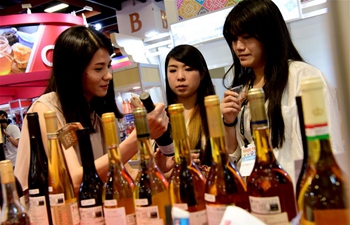
The Industrial Expo for Comprehensive Straw Utilization was held Monday and Tuesday in Hefei, capital of east China's Anhui Province, attracting more than 200 enterprises worldwide to showcase their wisdom of straw utilization.
"We buy crop straws from local farmers and transform them into home decorations and festival supplies, which are well received in western countries," said Fang Hong, general manager of an Anhui-based company specializing in straw-made artworks.
Fang said her company, Anhui Home & Fun Arts and Crafts Co. Ltd, utilized 1,000 tonnes of straws every year, notching up a total of 15 million U.S. dollars as of 2018 on exporting about 3,000 kinds of products to more than 30 countries and regions.
Thanks to business people like Fang, the comprehensive utilization rate of crop straw in Anhui Province reached nearly 89 percent last year, with the total output value of the whole industry chain for straw utilization hitting 11 billion yuan (about 1.6 billion U.S. dollars), according to Lu Shiren, director of the provincial department of agriculture and rural affairs.
"Compared with ceramics and plastics, straw-made products are more environmentally friendly," Fang said.
As a large agricultural country, China produces around 900 million tonnes of crop straws every year, according to statistics from the Ministry of Agriculture and Rural Affairs.
Farmers like Liu Zhenghong traditionally burned straws after harvests to clear the field, which was blamed as a major source of air pollution in rural China.
With the environment protection campaign progresses, the burning of straws has been banned, and its comprehensive utilization has become a priority.
According to this year's "No.1 central document," an annual policy statement released by Chinese central authorities, the country will lift its straw utilization rate to at least 85 percent by 2020.
Turning the waste into fertilizer is one of the most direct and convenient ways.
"We create an enclosed environment with polymer films, where straws can be fermented into fertilizers with the help of specially-made leavening agents in four to eight weeks," said Wang Jiulong at the expo, who is the technical director of Zhejiang EcoPro Agro Technology Co., Ltd.
The process can be conducted anywhere in a crop field without causing pollution or harm to the surrounding environment, he added. "With a phone application, farmers are even able to monitor and control the whole fermenting process through clicks on their screens."
Exploration concerning the utilization of straw in developing clean energy is also underway.
"We use gasifiers to transform the agricultural wastes, such as rice husk, fruit shell, and crop straw, into biomass gas, which can generate electricity," said Lu Wanbao at the expo, who is the vice president of Debo Bioenergy Science & Technology Co., Ltd.
Lu said one gasifier in his company could deal with 25,000 tonnes of straws every year. "A tonne of straws is sold for about 400 yuan but can generate about 800 yuan of value after processing."
From trash to treasure, the small straw is not a burden for Liu Zhengdong anymore. "It's so great that agricultural waste could be turned into wealth."