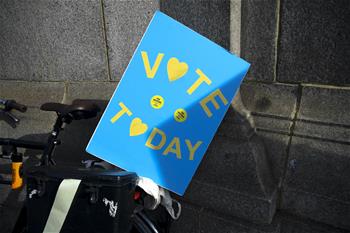
BRUSSELS, May 23 (Xinhua) -- Citizens across the European Union are set to head to the polls to vote on the makeup of a new European Parliament starting Thursday and lasting until Sunday evening.
According to the European Parliament, the last European elections in 2014 were the largest transnational elections ever held at the same time and this year over 400 million citizens are eligible to vote.
With some rules applying across EU and other details being decided on the national level, how exactly these massive elections work can be difficult to understand. Here's basic information on how this week's vote should go forward.
EU-WIDE RULES
Citizens of the 28 EU members will vote over the course of four days to elect 751 Members of European Parliament (MEPs) to five-year terms. The principle of "direct universal suffrage" has been in place since European elections in 1979, while the Treaty of Lisbon, which entered into force in 2009, established the right to vote and to stand as a candidate for every adult EU citizen as a fundamental right.
The elections are based on a system of proportional representation, a must be via either a list system, or a single transferable vote system. This means that countries with the largest populations gain the most seats, with Germany's 83 million citizens represented by 96 MEPs, and Malta's nearly half-million citizens represented by six MEPs. While this gives large populations bigger numbers in the European Parliament, smaller member states get increased influence for each individual legislator, with much lower ratios of citizens to MEPs.
EU treaties block MEPs from most "double-duty" arrangements, preventing elected European legislators from serving simultaneously in other European Union institutions, government positions and national parliaments.
NATIONAL DIFFERENCES
Despite common principles to guide the process, there are many variations on how European elections are held throughout the EU, starting with election dates.
The first votes will be cast Thursday in the Netherlands and Britain. Friday it will be the Republic of Ireland's turn, whereas the Czech Republic will vote on Friday and Saturday. Latvia, Malta, and Slovakia will go to the polls on Saturday. The rest of the EU members, including France, Germany and Spain will vote on Sunday. Italy will see the last votes cast.
National governments determine whether a country is treated as a single constituency, or is divided into several regional constituencies. Other variations between members include differences in legal voting ages (though most are set at 18), compulsory voting in some members, voting systems, nomination procedures, campaign rules and the validation of results.
TIMING OF RESULTS
Official national results are not allowed to be announced before all voting stations have closed, meaning that no results will be available before Italian polls close at 11 p.m. local time on Sunday.
First results are expected to be announced then, with early-voting countries, such as Britain, the Netherlands and the Republic of Ireland likely to report earliest on Sunday night.