 ?
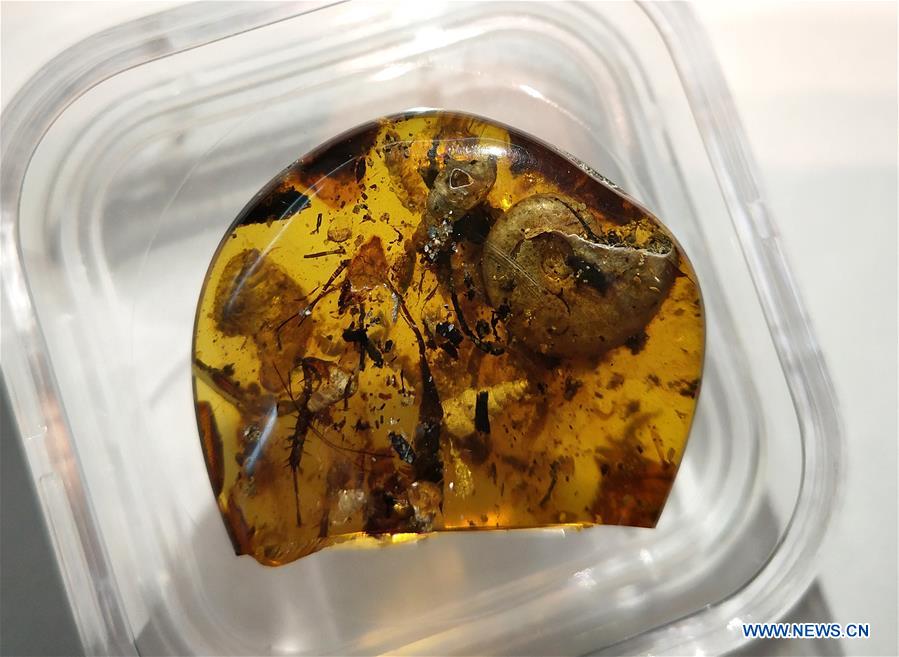
?Photo taken on May 14, 2019 shows the first known amber encasing an ancient sea animal called ammonite at the Nanjing Institute of Geology and Palaeontology of the Chinese Academy of Sciences (NIGPAS) in Nanjing, east China's Jiangsu Province. An international group led by Chinese scientists identified the first known amber encasing an ancient sea animal called ammonite about 100 million years ago. The study published on Monday in the Proceedings of the National Academy of Sciences described the 6.08 gram amber, which is 33 mm long, 9.5 mm wide and 29 mm high. The discovery provided a clue to ancient coastal forest ecology. (Xinhua/Sun Can)
WASHINGTON, May 13 (Xinhua) -- An international group led by Chinese scientists identified the first known amber encasing an ancient sea animal called ammonite about 100 million years ago.
The study published on Monday in the Proceedings of the National Academy of Sciences described the 6.08 gram amber, which is 33 mm long, 9.5 mm wide and 29 mm high. The discovery provided a clue to ancient coastal forest ecology.
While many terrestrial plants and animals are preserved by amber inclusions, it is rare to find sea life trapped in amber, according to the study.
The researchers from the Nanjing Institute of Geology and Palaeontology of the Chinese Academy of Sciences (NIGPAS) used X-ray to obtain high-resolution three-dimensional images of the ammonite including its convoluted sutures, key features for identifying the ammonite.
They found that the ammonite is a juvenile one, belonging to a group of ammonite living about 105 million to 93 million years ago. It is a rare example of dating of sea animal using amber inclusions.
The shells are all empty with no soft-tissue, revealing that the organisms were long dead and removed away by the time they were engulfed by resin.
Wang Bo, a researcher from NIGPAS and the paper's corresponding author, told Xinhua that the ancient coastal forest in Myanmar produced resin and encased the dead ammonite in the beach before becoming the amber. The authors also included researchers from National Museum of Scotland, Oxford University and Indiana University.
Sea snails and sea slaters are included by the amber. The amber also engulfed some terrestrial animals including spiders, cockroaches, beetles and wasps, most of which would have lived on the forest floor, according to the study.
The most likely explanation for the appearance of both marine and terrestrial organisms within the amber is that a sandy beach covered with shells was located close to resin-producing trees, according to the researchers.