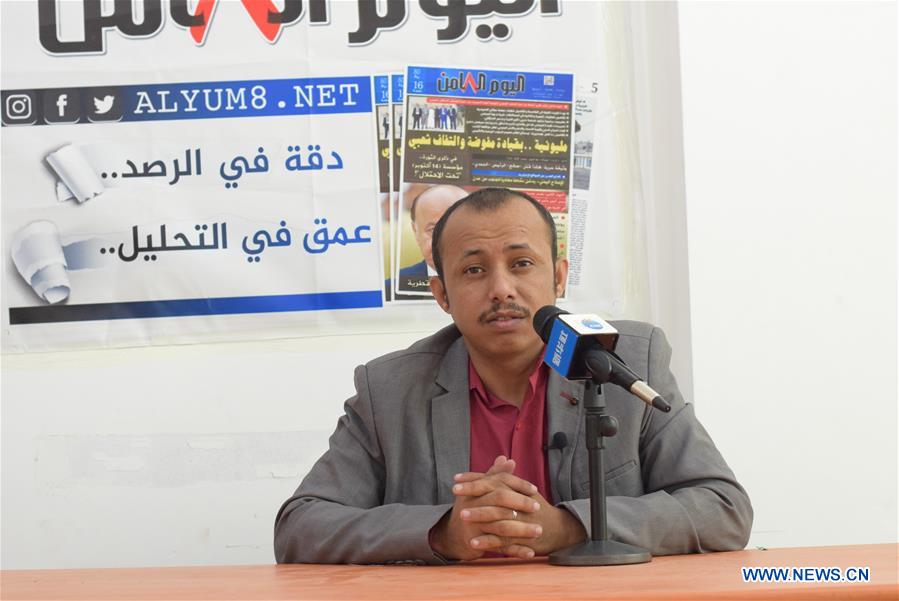
Aden-based political observer Saleh Abu Odal speaks in an interview with Xinhua in Aden, Yemen, on April 11, 2019. Yemeni political observers say that the U.S. decision on designating Iran's Islamic Revolutionary Guard Corps (IRGC) as a "foreign terrorist organization" will have limited impact on the ongoing conflict in Yemen. (Xinhua/Murad Abdo)
by Murad Abdo
ADEN, Yemen, April 11 (Xinhua) -- Yemeni political observers say that the U.S. decision on designating Iran's Islamic Revolution Guards Corps (IRGC) as a "foreign terrorist organization" will have limited impact on the ongoing conflict in Yemen.
Yemen's internationally-recognized government lauded the U.S. decision, considering it an important step in the right direction.
In a statement revealed by the country's Foreign Ministry, the Saudi-backed Yemeni government said that "the U.S. move comes in the right direction for its upcoming positive impact upon security and peace in the region and world."
The statement stressed the importance of the U.S. decision in "pushing the regime in Iran to change its behavior and stop its practices in destabilizing the region's security and stability interference in the internal affairs of Arab countries."
However, local Yemeni analysts and political observers interviewed by Xinhua said that the U.S. decision will have limited impact on the ongoing conflict in the war-torn Arab country.
Mohsen Naji, a strategic military expert based in Aden province, said that blacklisting Iran's IRGC will not largely affect the ongoing fighting in Yemen, but may lead to serious impacts in the turbulent Middle Eastern region.
He said that "the strategic relations between the Houthi rebels and Iran won't be largely harmed by U.S. decision, because the Houthis are considered as one of Iran's key loyal militias in the region. Iran will not leave its proxies in the region including Houthis despite all the recent U.S. sanctions."
The Yemeni military expert expected that the internal conflict taking place in the country will see no end in the near future, as other countries participate in funding the Houthi rebels to stay longer in fighting the Saudi-backed Yemeni government forces.
"Houthis receive support from several unannounced parties and other groups in the Middle Eastern region, so blacklisting Iran's IRGC won't have an impact on Yemen's internal conflict that will continue in further escalation," said Naji.
He concluded his exclusive interview with Xinhua by saying that "the U.S. decision mainly aims at mounting the pressures on the Iranians just to change their expanding political role in region. Even Iran itself will not be affected by this decision but regional conflicts will be triggered as a consequence of the decision."
The Houthis, aligned with Iran, launched a large military campaign and seized the capital Sanaa in late 2014, forcing Yemen's President Abdu-Rabbu Mansour Hadi and his government to flee into the southern port city of Aden.
Subsequently, the pro-Houthi forces, backed by armored vehicles, attacked Aden and shelled Hadi's Republican Palace, leading him to escape again into exile in neighboring Saudi Arabia.
Saudi Arabia and other Arab countries intervened militarily and began pounding the Houthi-controlled capital Sanaa in March 2015 in response to an official public request from Hadi to protect Yemen and roll back Iran's influence.
The conflict between the Houthis and the Saudi-backed Yemeni government has recently entered its fifth year, aggravating the suffering of Yemenis and deepening the world's worst humanitarian crisis.
For the Aden-based political observer, Saleh Abu Odal, designating Iran's IRGC as a foreign terrorist organization will reduce the involvement and interventions of Iran in the Yemen's internal crisis and may positively serve in pushing the warring sides to achieve a political settlement.
"There are also serious consequences for the American decision as Iran is considered as a strong regional power and may fuel or escalate the conflicts in Yemen and other countries as a reaction to that decision," said Saleh Abu Odal.
Earlier this year, Yemen's Saudi-backed government urged the United States to designate the Houthi group as a foreign terrorist organization, saying that some attacks committed by members of the Houthi group amount to war crimes.
"Houthis staged a coup against Yemen's legitimate authorities and caused the humanitarian crisis. Designating this group as a terrorist organization will be a good step," said Abu Odal.
However, other Yemeni analysts warned that blacklisting the Houthi group could complicate recent efforts exerted by United Nations aimed at pushing for a political solution.
"The Houthi group works as an active military force in countering terrorism and has strong links with the international community including with the United States that needs the Houthis for that purpose," said Ahmed Amary, a local Yemeni journalist and writer.
Yemen and the Saudi-led Arab coalition accuse Iran of aggravating instability in Yemen by backing and supplying Houthi rebels with weapons, which has been repeatedly denied by both Houthis and Iran.
The Houthi rebels backed by some anti-government army units have been controlling much of Yemen's north by military force, including the capital Sanaa since 2014.
The internal conflict has killed tens of thousands of people mostly civilians, displaced three million and pushed over 20 million on the brink of famine.