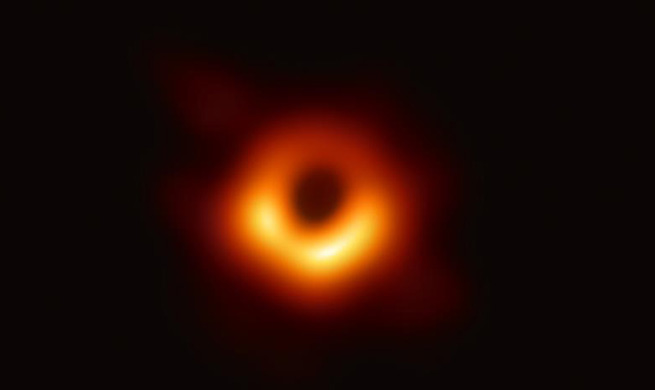
BONN, Germany, April 10 (Xinhua) -- International researchers, including Chinese astronomers, have revealed on Wednesday the first-ever image of a supermassive black hole and its shadow at coordinated press conferences in six places worldwide, including Shanghai, China.
The ultimate goal of imaging black holes is "to understand the formation of the universe," said Anton Zensus, director of Germany's Max Planck Institute for Radio Astronomy, which has undertaken data correlation work behind the image.
"A black hole forms when you have atoms and matter coalesce or move together under the force of gravitation, forming a body where the atoms and the subatomic particles are packed as densely as possible," Zensus told Xinhua here before the image was revealed.
By imaging it, "we want to see if the image agrees with the predictions of the general relativity," he said. "But our ultimate desire is to understand the formation of the universe."
The donut-like black hole image was created by the Event Horizon Telescope (EHT) -- a planet-scale array of eight ground-based radio telescopes forged through international collaboration. Two black holes became the objects of observation in 2017.
"One is Sagittarius A* at the center of our galaxy, and the other is Messier 87 in a neighboring galaxy," Zensus said. Considering their mass and distance to the Earth, "the two are ideal to observe in our current capability."
The technique applied for the EHT observations is called very-long-baseline interferometry (VLBI), which enables the highest resolutions in astronomy by coupling a number of radio telescopes distributed across the Earth.
The resolution of the worldwide network of radio telescopes at that wavelength corresponds to the size of a tennis ball in the distance of the moon. "In daily life, if the Earth were flat, we could look from here in Bonn at what people in New York are reading in a newspaper with such resolution," said Zensus.
He said imaging collaboration began roughly two years ago. The Max Planck Institute for Radio Astronomy in Bonn and the Massachusetts Institute of Technology in Boston, the United States, have correlated the data.
The Chinese city of Shanghai is one of the six places worldwide to release the image and results. "We chose to have press conferences in all the regions where there is major participation in the project," said Zensus.
The Shanghai Astronomical Observatory of Chinese Academy of Sciences took part in the observations using the James Clerk Maxwell Telescope in Hawaii, United States, one of eight telescopes. "Many Chinese scientific institutes and scientists have also been involved in data analysis and result interpretation work," he added.
"Other Chinese observatories have also made complementary observations of the EHT. Chinese telescopes are particularly important in arrays we use regularly. We hope new Chinese millimeter telescopes could participate in our observations later," Zensus said.
Regarding future plans for the EHT, Zensus said that scientists will "continue to observe the two objects in different stages of their activity and therefore refine our understanding of how they form and evolve."
"We want to extend and improve the method so that we can have better imaging quality," Zensus said. "So in the next few years, we will continue to work on our instruments and each year have an observing campaign to improve the quality of our images and to get new images."