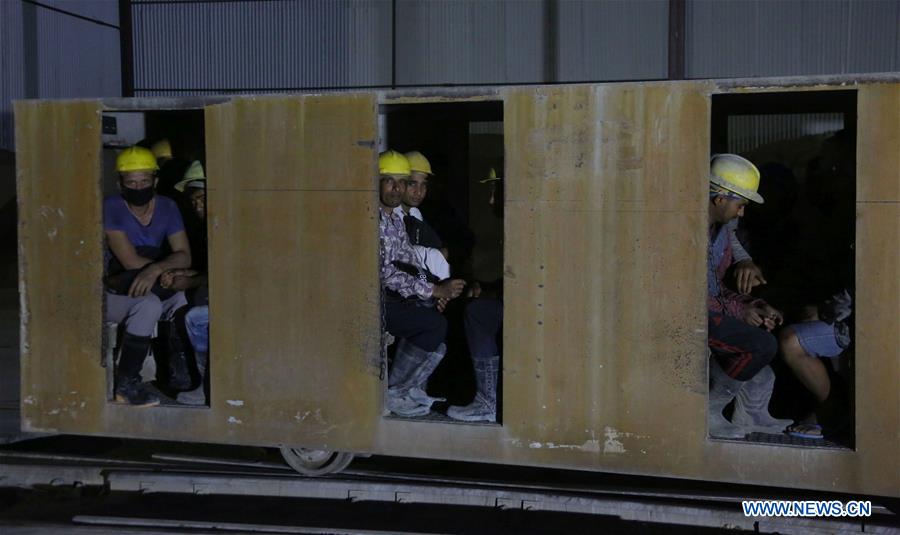
Lila Ram Acharya (C) and other workers prepare to go to work inside the tunnel of the Bheri Babai Diversion Multipurpose Project in Surkhet, west Nepal, March 25, 2019. Forty-six-year-old Lila Ram Acharya began to work in the Bheri Babai Diversion Multipurpose Project two years ago and his wife ran a hotel to serve meal to the project workers. The couple are well settled and economically benefited due to the China-constructed project. (Xinhua/Sunil Sharma)
by Zhou Shengping, Shristi Kafle
SURKHET, Nepal, April 10 (Xinhua) -- Forty-six-year-old Lila Ram Acharya, a villager in Babai valley one hour away from Nepal's western city Nepalgunj, recalled to Xinhua how his life changed in the past three years.
Born in a poor family, Acharya was a grade 3 dropout without any skills, which always led him to an idle end. His wife Laxmi Jaisi is illiterate, and their two sons have been struggling to earn tuition for college.
The pressure to prepare their sons' tuition fees and support his family forced Acharya to go to India where he worked for a few months but earned not much.
When one door shuts, another opens, as the old adage goes.
Their life changed after the Bheri Babai Diversion Multipurpose Project (BBDMP), one of Nepal's national and highly revered projects, was inaugurated in April 2015, with an aim to enhance agricultural production by providing year-round irrigation and generating reliable electricity.
To implement this strategic project in the Himalayan nation, the Chinese constructor, China Overseas Engineering Group Co. Ltd., has been using a tunnel boring machine (TBM) for the first time in Nepal, to dig a 12.2 km long tunnel, which will allow the surplus water from the Bheri river to flow into the lower places of the Babai river.
The unprecedented inter-basin water transfer project has been conceptualized to provide a year-round irrigation facility to accommodate 51,000 hectares of agricultural land in both the Banke and Bardiya districts.
"I have been working here as a laborer for the last two years. The job is good, so is the income. As compared to the past, life is far better now," Acharya told Xinhua at the construction site.
Among more than 2,100 local people have been recruited for the major project, and Acharya is one of the 600 workers working on-site. Every evening, he boards a company train for a 40 minute ride to reach the inside of the tunnel, where he is stationed.
The father of two works for 12 hours every day inside the tunnel and earns about Rs 35,000 (about 350 U.S. dollars) every month, plus overtime pay, about three times the minimum wage set by the Nepali government which stands at Rs 13,450 (about 121 U.S. dollars) per month.
His 36-year-old wife Laxmi Jaisi operates a hotel, serving local workers with typical Nepali food, including rice and curry. She cooks two meals a day for her regular customers, charging Rs 3500 (about 35 U.S. dollars) per person per month.
"It is a good income for us and we are now able to educate our sons," Laxmi told Xinhua while preparing lunch boxes for workers, adding that life is far better than before.
The Chinese contractor also helped them to build a new concrete house with four rooms in Chepang village just across the Babai River, and they rent out two of the rooms.
Saligram Adhikari, mayor of the Basgadhi municipality of Bardiya district, told Xinhua, "The project is linked with villages where people are mostly poor. They have received employment opportunities offering good incomes."
At a time when most of the young people in nearby villages were either unemployed or engaged in agriculture on a small scale or had moved to the Gulf and Middle East in search of employment opportunities, the Chinese construction project has provided jobs to more than 2,100 locals.
According to project manager Hu Tianran, the main part of the project is in its final phase.
Acharya, however, is not worried about losing his job.
He said confidently that he would find another similar job without much difficulty, as he has now acquired the requisite skills learnt from his Chinese colleagues on the construction site over the past two years.