VENICE, Italy, Feb. 19 (Xinhua) -- The Carnival of Venice, which runs from Feb. 16 to March 5, attracts thousands of visitors each year.
This ancient festival is world-famous for its elaborate masks, which lend a charming and mysterious air to the event, with visitors wearing all styles of them everywhere in the lagoon-festooned city.
But why do people wear masks? How long has this tradition of mask-wearing in Venice been practiced? And how to make a genuine Venetian mask?
To answer these questions, a special event entitled "Venice: a story of masks" was launched for visitors, where free cultural presentations are held by professional mask-makers.
"The earliest written records of Venetian masks date back to the 13th century, when Venice was still a republic rather than a part of Italy," Mario Belloni, founder of the 35-year-old Ca' Macana mask workshop, told Xinhua. Ca' Macana is one of the oldest authentic mask workshops in town.
"When Napoleon came in the 18th century, this culture ended as the Republic of Venice was over. So the Venetian masks have a history of more than 500 years," he said.
According to Belloni, masks were part of the Venetian people's daily life during that period of history, and the rules on how to wear a mask were even written into the law. Venetians were allowed to wear masks for more than half of the time in a year, for over six months starting on Oct. 5.
The typical attire for Venetians at that time included a black cloak, a tricorn black hat and a traditional Venetian mask named "Bauta," Belloni explained. Donning such an outfit, people could hide their identity, class and even gender. "The members of that society were more equal and people were free to do whatever they wanted to do," he said.
"However, the ancient techniques of mask-making have been completely lost," said Belloni. "We had to look for clues in history books, and try new methods and materials, and finally we recreated the techniques."
It was a difficult challenge, he said, "because no one could tell you what to do. But it's a creative job to design and create new masks, which brings me a lot of joy and fun."
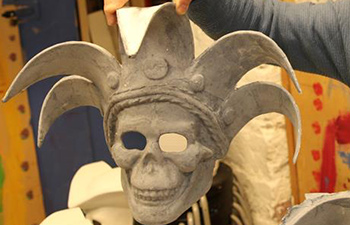
In his workshop, Belloni showed the procedure of mask-making. From the creation of a clay model sculpture and negative cast of plaster to the sticking and extraction of paper layers, each step requires patience and meticulousness.
The workshop also offered hands-on courses where visitors could paint their own Venetian masks.
According to Belloni, the number of Chinese visitors attending mask-making courses in Venice has been on the increase. "I understand that in ancient China there was also a culture of mask-wearing," said Belloni.
"We are trying to recruit a worker who speaks Chinese so that we can communicate more conveniently," he said.