BEIJING, Jan. 17 (Xinhua) -- 2018 was a fruitful year for Zhao Ruqi, general manager of Dongsu Group, a multi-faceted conglomerate based in Cangzhou, north China's Hebei Province.
Over the past year, about 8,000 wholesale sellers who closed their shops in Beijing moved to Cangzhou, where Dongsu Group's garment wholesale arm, Mingzhu Commerce and Trade Center, is located. On Aug. 22, more than 1,000 winter coat sellers opened their new businesses there, some 200 km away from Beijing.
"We are now striving to develop ourselves into a national trading center for cotton-padded clothes and down jackets," Zhao said.
WIN-WIN STRATEGY
Five years ago, China initiated a strategy to integrate the development of Beijing, Tianjin, and Hebei to create a model with a better economic structure, cleaner environment, and improved public services. A prominent task is to move the non-capital functions out of Beijing to treat "urban ills" in the Chinese national capital, such as traffic jams and pollution.
According to a guideline released in April 2015, the key functions of politics, culture, international communication, and technical innovation will be prioritized, while other sectors will be moved out of Beijing.
The relocation of general merchandise and clothes markets in downtown Beijing is one of the measures.
Zhao said more than 10,000 shops from markets like Dahongmen and Beijing Zoo garment markets had moved to Cangzhou, with 2,000 clothes manufacturing plants relocated there, bringing about tens of thousands of jobs.
Tian Xiuhua, chairman of a telecommunication sales company which shifted part of its business from Beijing to Tianjin and Hebei, said the labor cost had significantly dropped thanks to the relocation and the sales market would also improve.
"Many young employees are tired of the rising living costs in Beijing, so the relocation has benefited them a lot," he said.
Other measures to clear space in Beijing include the closing of manufacturing businesses, relocation of hospitals and schools and shifting administrative departments of the Beijing Municipal Government to Tongzhou District in the city's eastern suburbs.
At the ongoing municipal legislative session, Beijing Mayor Chen Jining said 204 markets and logistics centers were relocated or upgraded last year, plus the closing of 656 manufacturing companies in the city.
In 2019, more than 300 manufacturing firms and 66 markets and logistics centers, usually high-polluting or low-end industries, will be phased out or moved to nearby regions, said Chen in the government report.
Resources from Beijing and Tianjin, including talents, have injected impetus to the less developed areas. The city of Xinji, Hebei Province, for instance, has established cooperation with 15 academicians, to provide technical and research support in industries such as leather, machine manufacturing, petrochemical engineering, energy saving, biotechnology and electronic information.
"An academician not only represents the highest scientific and research levels in his or her field but also has a powerful team that can help with research and development of companies here," said Di Yi, the Party chief of Xinji and a deputy to the Hebei Provincial People's Congress.
According to him, the city's economy grew 7 percent in 2018, 0.4 percentage points higher than the provincial level, to 48 billion yuan (about 7.16 billion U.S. dollars).
TRANSPORT INTERCONNECTIVITY
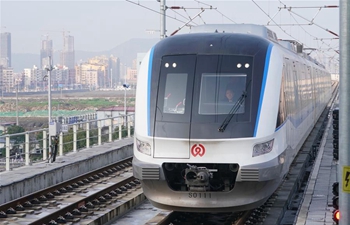
Many high-speed railway lines have run through Beijing and the neighboring area, making relocation of the industrial projects practical. People from Beijing will arrive in cities like Tianjin, Langfang and Cangzhou in less than one hour.
The high-speed railway line connecting Beijing and Zhangjiakou, Hebei Province, where many events of the 2022 Winter Olympics will take place, will be in operation this year, while the expressway between Beijing's Yanqing District and Zhangjiakou's Chongli, two major venues for the Winter Olympics events, will also begin service, Hebei governor Xu Qin said in the provincial government report.
By 2018, more than 40 inter-province bus lines, totaling 2,800 km in length, had been in operation between Beijing and 17 neighboring districts or cities in Hebei, carrying 400,000 passengers every day.
According to Tianjin's annual government work report, construction work on a high-speed railway connecting Tianjin and Beijing's new airport in Daxing District will start in 2019.
Tianjin will also contribute to the construction and development of Xiongan New Area, with a series of measures taken, including expediting construction of transportation infrastructure connecting Tianjin and Xiongan and creating convenient access to the sea for Xiongan via Tianjin.
Beijing, Tianjin and Hebei also work together to tackle air and water pollution.
In the meantime, central authorities issued a special guideline in late November 2018 to establish a more effective mechanism for integrated regional development.
The guideline stressed that the integrated development of the Beijing-Tianjin-Hebei region, which has the removal of non-capital functions out of Beijing as a grab, should focus on the readjustment of regional economic structure and space layout to redistribute the resources of densely populated megacities in pursuit of a model to tackle the "urban ills."
General manager Zhao is confident about Cangzhou's wholesale market development in the future. About 20 km away from the Mingzhu Commerce and Trading Center, Dongsu Group is building a new town for international garment trading, he said.
Covering an area of more than 1 million square meters, the projected town will consist of a complete industrial chain for garment-making, including designing, processing and marketing functions.
"I am optimistic about the prospects of the project," said Zhao. According to him, Dongsu Group has signed contracts with 5,000 companies for entering the town upon its completion.