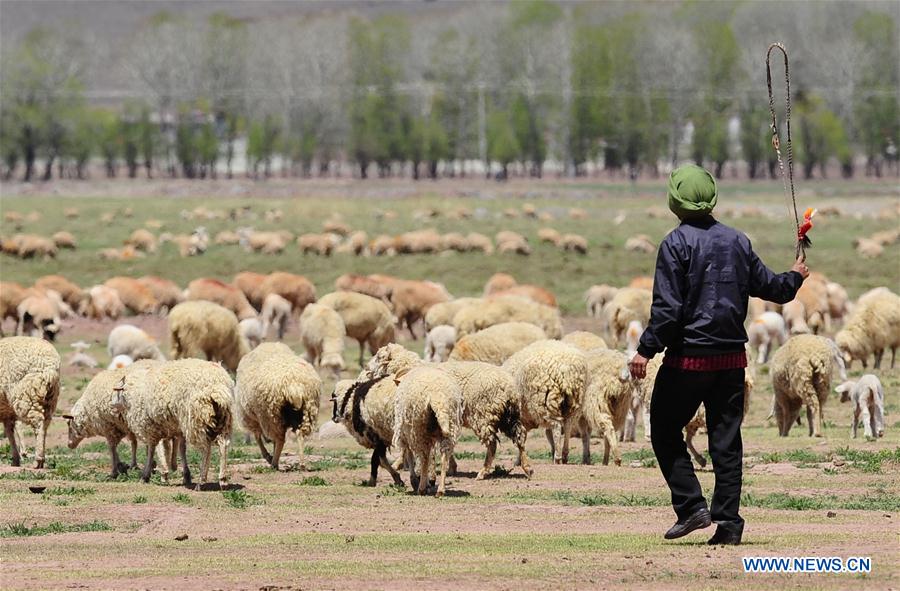
A herdsman grazes on a family farm at Jurong Village of Ganqu Town in Lhunzhub County of Lhasa, capital of southwest China's Tibet Autonomous Region, May 7, 2013. China's plateau city Lhasa announced on Jan. 7, 2019 that the last remaining 44,000 people were taken off the poverty list last year, signaling a victory in the campaign against destitution. A total of 44,439 people lived below the poverty line, defined as per capita annual income of 2,300 yuan (around 335 U.S. dollars) at 2010 prices, in Lhasa. Through creating jobs, relocation from less-inhabitable places, education funding and social welfare programs, residents perplexed by poverty now earn much more than they used to, according to local authority. Lhasa is the first to complete its poverty reduction target, leading other cities in Tibet. (Xinhua/Liu Kun)
LHASA, Jan. 7 (Xinhua) -- China's plateau city Lhasa announced on Monday that the last remaining 44,000 people were taken off the poverty list last year, signaling a victory in the campaign against destitution.
A total of 44,439 people lived below the poverty line, defined as per capita annual income of 2,300 yuan (around 335 U.S. dollars) at 2010 prices, in Lhasa, capital of Tibet Autonomous Region.
Through creating jobs, relocation from less-inhabitable places, education funding and social welfare programs, residents perplexed by poverty now earn much more than they used to, said Pi Zhishuai, deputy director of the Lhasa poverty reduction office.
Lhasa spent more than 9.3 billion yuan (1.35 billion U.S. dollars) in creating jobs by developing modern farming, craft-making and other industries. Another 1.4 billion yuan (200 million U.S. dollars) was spent on financing resettlement in more habitable places.
Another big chunk of investment, roughly 800 million yuan, was spent on free food, free dormitories, and scholarships for children of farmers and herders.
Lhasa is the first to complete its poverty reduction target, leading other cities in Tibet, he said.
More than 85 percent of the land in Tibet is located over 4,000 meters above sea level. Harsh natural conditions have been part of the causes of entrenched poverty.
In 2015, the Chinese government set a goal of eradicating absolute poverty by 2020 to create a moderately prosperous society.
Across Tibet, a total of 181,000 people were taken off the poverty list in 2018. Roughly 110,000 people still live below the poverty line.
The poverty rate has been declining in Tibet since the battle against abject poverty started. The poverty rate dropped to 7.9 percent by the end of 2017 from 25.2 percent at the end of 2015.