BEIJING, Nov. 20 (Xinhua) -- Digital innovations are reshaping the economy in the Asia Pacific, with China at the forefront and providing strong momentum for the transformation.
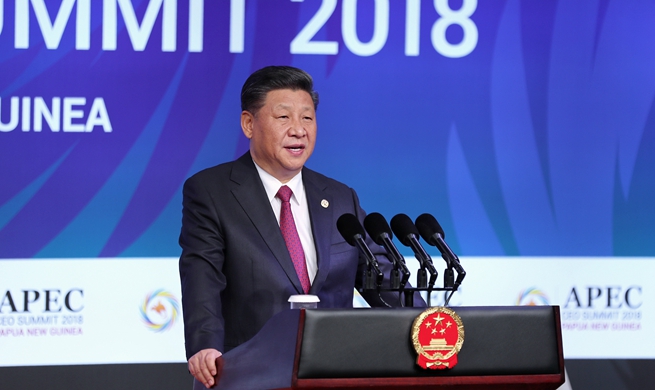
Building a digital future topped the agenda of the 26th Asia-Pacific Economic Cooperation (APEC) Leaders' Meeting, which concluded at Papua New Guinea's capital of Port Moresby on Sunday.
Asian economies are moving faster than their global peers in digitalization and have benefited from the shift.
Asia is home to seven of the world's top 10 economies in terms of the share of information and communications technology sector in GDP, according to a report released by the International Monetary Fund (IMF) last month.
Over the past two decades, digital innovation accounted for nearly one-third of Asia's per capita GDP growth, the report showed.
"Digitalization can be a new source of growth for Asia," said Changyong Rhee, director of IMF's Asia and Pacific Department. Measures to improve education, infrastructure and the regulatory environment would help make digitalization "an even more important engine of growth in the near future," he noted.
The outlook of the region's digital economy is promising. By 2021, the digital transformation would add an estimated 1.16 trillion U.S. dollars to Asia Pacific's GDP, according to a business research produced by Microsoft in partnership with IDC Asia/Pacific early this year.
As a leading innovator and investor in digital technologies, China is playing a dynamic role in driving the region's digital economy growth.
China's digital economy reached 27.2 trillion yuan (about 3.9 trillion U.S. dollars) in 2017, up 20.3 percent year on year, according to data from the National Bureau of Statistics. The digital economy accounted for 32.9 percent of the country's GDP last year, 2.6 percentage points higher than the previous year.
E-commerce is one of the fastest growing sectors. The current value of China's e-commerce transactions is estimated to be larger than in France, Germany, Japan, the United Kingdom and the United States combined, according to a report from the McKinsey Global Institute.
China has promised to share the opportunities of the digital economy with other nations for inclusive and more sustainable growth.
"It [China] is already shaping the global digital landscape and supporting and inspiring entrepreneurship far beyond its own borders," the McKinsey report said, noting that China's outbound venture capital totaled 38 billion dollars in the 2014-2016 period, up from 6 billion dollars in 2011-2013.
Chinese technology giants like Alibaba and Huawei have expanded their presence in Asia Pacific countries including Malaysia and Papua New Guinea, offering digital services such as mobile payment and e-trade platforms and providing internet infrastructure to create jobs and momentum for the local economy.
"Digital economy means an open economy. It has no future without opening up. China views the digital economy as a common opportunity for global development," said Zhuang Rongwen, director of the Cyberspace Administration of China.
"We are willing to deepen cooperation with other countries to further promote the digital economy and make a bigger cake of development through cross-border e-commerce and open markets," Zhuang said.