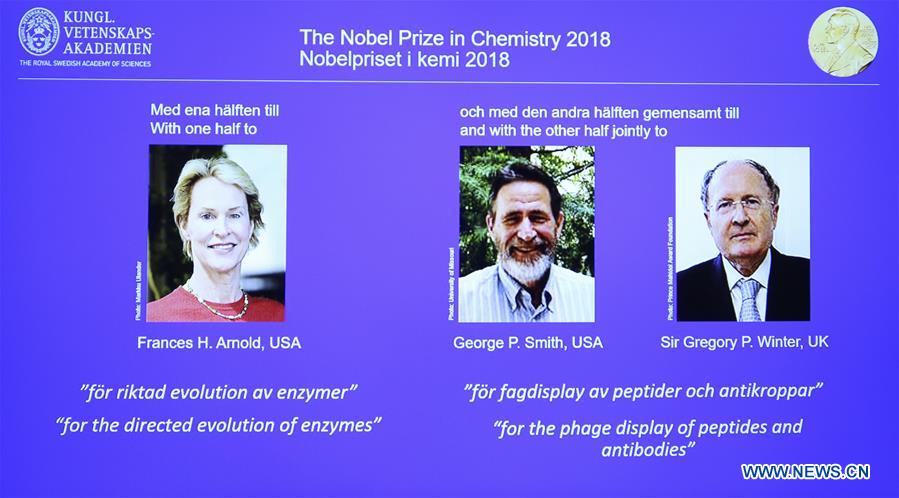
Photo taken on Oct. 3, 2018 shows a screen displaying the portraits of awarded scientists Frances H. Arnold of the United States (L), George P. Smith of the United States (C) and Sir Gregory P. Winter of the UK (R) for the 2018 Nobel Prize in Chemistry during a press conference at the Royal Swedish Academy of Sciences in Stockholm, Sweden. The 2018 Nobel Prize in Chemistry is awarded to three scientists, the Royal Swedish Academy of Sciences announced on Wednesday. (Xinhua/Ye Pingfan)
STOCKHOLM, Oct. 3 (Xinhua) -- The 2018 Nobel Prize in Chemistry is being awarded to three scientists who have taken control of evolution and used the same principles to develop proteins that solve humankind's chemical problems, the Royal Swedish Academy of Sciences announced Wednesday.
The academy has decided to divide the prize with one half given to Frances H. Arnold and the other half jointly to George P. Smith and Sir Gregory P. Winter.
Arnold conducted the first directed evolution of enzymes, which are proteins that catalyze chemical reactions. Enzymes produced through directed evolution are used to manufacture everything from biofuels to pharmaceuticals.
Smith developed a method known as phage display, where a bacteriophage -- a virus that infects bacteria -- can be used to evolve new proteins.
Winter used phage display to produce new pharmaceuticals. Today phage display has produced antibodies that can neutralize toxins, counteract autoimmune diseases and treat metastatic cancer.