 ?
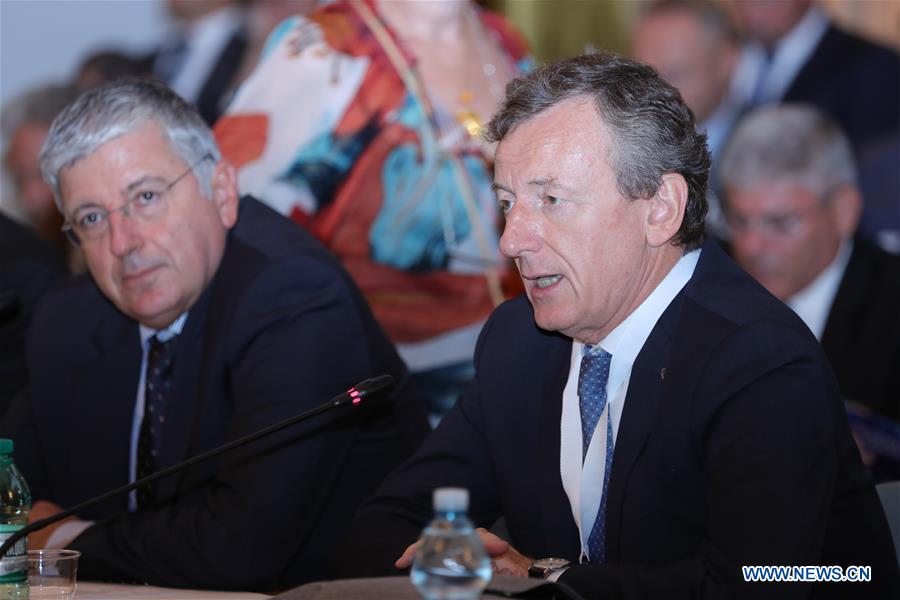
?Roberto Battiston (R), President of the Italian Space Agency (ASI), delivers a speech during a conference in Rome, Italy, Sept. 17, 2018. Space technology and exploration can aid sustainable development on Earth, officials said at the launch of Italy's new Interministerial Committee on Space (COMINT) at a conference in Rome on Monday. Participants at the conference organized by Italy's Foreign Ministry and the Italian Space Agency (ASI) included ministry officials, aerospace business leaders, and scientists. (Xinhua/Cheng Tingting)
by Stefania Fumo
ROME, Sept. 17 (Xinhua) -- Space technology and exploration can aid sustainable development on Earth, officials said at the launch of Italy's new Interministerial Committee on Space (COMINT) at a conference in Rome on Monday.
Participants at the conference organized by Italy's Foreign Ministry and the Italian Space Agency (ASI) included ministry officials, aerospace business leaders, and scientists.
"This event represents this government's strong commitment to innovation and new technologies," said Foreign Undersecretary Manlio Di Stefano.
"Space is significant to us in terms of quality of life, public services for citizens, and sustainable development objectives."
Deputy Foreign Minister Emanuela Claudia Del Re said that Italy is a leader in space research and exploration, and this sector must become "a launching pad for Italy's sustainable development."
"Our country is on the frontlines in terms of reaching the goals of the (United Nations - UN) 2030 Agenda (for Sustainable Development) through the use of technologies with applications in space," said Del Re.
Unveiled in 2015, the UN 2030 Agenda sets 17 goals which include zero poverty and hunger, water management, sustainable energy and farming, education, gender equality, jobs, and infrastructure.
Del Re said that advances in satellite technology can help Italy reach the 17 goals of the 2030 Agenda by "monitoring the atmosphere, climate, change, and the state of our land, soil, and oceans."
COMINT President Giancarlo Giorgetti, who also serves as cabinet undersecretary, said priorities will include new satellites for the COSMO SkyMed program.
COSMO SkyMed, a bilateral project involving Italy's ASI, the Italian Defence Ministry, and France, is a dual-use civilian and military program composed of four satellites that monitor the environment and carry out surveillance.
ASI President Roberto Battiston said the next great challenge for Italy and for the European Space Agency (ESA) is ExoMars 2020, a mission to deliver a European rover and a Russian surface platform to the surface of Mars.
The journey to Mars, which lies 5 billion km away from Earth, will take nine months, according to the ESA website.
The ExoMars rover will travel across the Martian surface to search for signs of life, collecting samples with a drill and analyzing them with next-generation instruments.
"We will look for ice beneath the Martian surface -- ice that hopefully will hold traces of biological phenomena from a very distant past," Battiston told conference participants.
Another huge effort by ESA and its members, including Italy, said Battiston, is the development of launchers "so that Europe can have autonomous access to space."
"If we can't access space on our own, we won't be able to do all the things we want to do," said Battiston.
Also in development at the European level is a program called the Space Rider, a ship that can "travel to space, stay there for a few months while it carries out technological and industrial tasks, and bring the finished products back to Earth," the ASI chief explained.
It is the only project that will allow Europe not only to go into space but also to return with the products of space activity, Battiston said.
In 2002-2016, Italy invested 15 million euros (over 17 million U.S. dollars) in bilateral scientific and industrial research and development programs.
In 2014-2016, Italy invested 6.3 million euros in bilateral science and technology cooperation projects with various countries, beginning with the United States (18 percent) and followed by China (14 percent) and Japan (9 percent), according to the Foreign Ministry.