XINING, Sept. 13 (Xinhua) -- A white dome, like a huge golf ball, sits in the Gobi Desert about 3,200 meters above sea level. Enclosed inside, a large telescope scans the vast Milky Way day and night.
The 21-meter-high dome was erected 35 kilometers east of Delingha City, northwest China's Qinghai Province, about three decades ago.
At first, it drew the attention of Mongolian herdsmen living nearby, as it looked like a huge yurt from a distance. On horses and camels, they came to look.
"Most mistook it as a meteorological station, and they often called to ask about the weather. We had to tell them again and again that we were observing the stars," laughs Pang Xinghai, a senior engineer who has worked at the Qinghai station of the Purple Mountain Observatory (PMO) for 36 years.
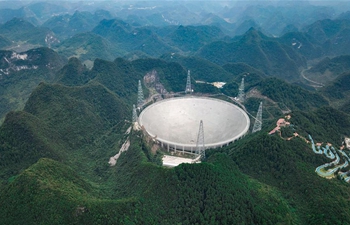
With a diameter of 13.7 meters, it is China's only large radio telescope working at the millimeter wave band, providing data for a series of key astronomical studies, and it's open to astronomers worldwide.
It is mainly used to study molecular clouds and the formation of stars, as well as planetary nebula, the evolution of stars, and interstellar matter, says Xu Ye, chief scientist at the station.
The dry weather and high altitude on the Qinghai-Tibet Plateau, known as the roof of the world, makes it the best site in Asia for millimeter-wave radio astronomical observation, Xu says.
The station is also home to other optical facilities, and is one of the ground stations for experiments conducted with the world's first quantum satellite, Quantum Experiments at Space Scale (QUESS).
TELESCOPE GUARDIANS
The telescope was constructed in the 1980s and put into use in 1990. Since then, scientists and engineers have stayed in the Gobi Desert's harsh environment for decades to peer into the boundless universe.
Ju Binggang, vice director of the station, who has worked there for 18 years, recalls how the road from Delingha City to the station was once so bad that their car bounced along for two to three hours every day.
The drinking water pumped from underground gave him diarrhea just after he arrived. The high altitude and dry weather gave the staff nose-bleeds, chapped lips and sleepless nights.
"Our duty is to ensure the smooth operation of the telescope. If there is any malfunction, we rush to repair it - even if it's midnight," Ju says.
Winter is the most important observation season, so the station never shuts during the Chinese Lunar New Year, the most important Chinese festival of family reunion.
"The core instrument of the telescope works at a temperature of around 269 degrees centigrade below zero. If we shut it down and restart it, the process will waste a lot of time and might cause accidents. So the telescope runs continuously for 10 months a year except for the rainy season in July and August," Xu Ye says.
Even during the rainy season, staff never rest.
"The telescope might become 'shortsighted', as the dish antenna is made of aluminum panels that could distort by expanding in the heat and contracting in the cold. So we overhaul the telescope during the rainy season," Ju says.
"Just after I arrived here, I thought the environment was bleak and life dull. As time went on, I fell in love with the life and work. When the night is clear, I love to enjoy the starry sky," Ju says. (more)