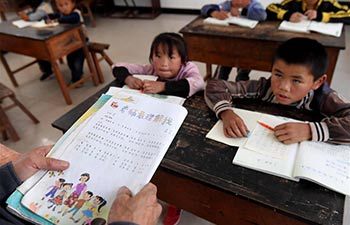
LA PAZ, Sept. 9 (Xinhua) -- Bolivia's literacy campaign is helping to strengthen the country's rich indigenous heritage by teaching native languages alongside Spanish, the program's general director, Ramiro Tolaba, said on Sunday.
Long before Spanish conquerors brought their language to the New World, indigenous communities throughout Bolivia had developed their own communication systems, including Aymara, Quechua, Guarani, Tacana, Besiro, Yuracare, Yawinawa and Chiman, all languages being taught today.
"We have to promote education in the 36 native languages ... it's the best way to reaffirm the heritage of the indigenous peoples and so far it is having favorable results for us," Tolaba, who works for the Education Ministry, told Xinhua.
Sept. 8 marked the International Literacy Day, as designated in 1966 by UNESCO, and the United Nations General Assembly has declared 2019 as the International Year of Indigenous Languages, based on a proposal made by Bolivia and the UN's Permanent Forum on Indigenous Issues.
To engender respect for indigenous ways of life, it's important "to make people literate in their own language, as we are doing in Bolivia," said Tolaba, adding Bolivia's Constitution recognizes all 36 languages as official ones.
In 2008, Bolivia was declared to be free of illiteracy when the illiteracy rate was reduced to 3.7 percent of the population, and the effort continues.
The rate was cut from 13.3 percent in 2001 to 2.4 percent today, but "the process needs to continue until we lower it to 2 percent, the optimum rate up to 2022," said Tolaba.
"We have succeeded in reversing not just illiteracy in general, but also illiteracy in native languages. We will continue to lower the level of illiteracy because it is a state policy, a right," Tolaba added.
The policy has been spearheaded by Bolivian President Evo Morales, the country's first indigenous head of state.