 ?
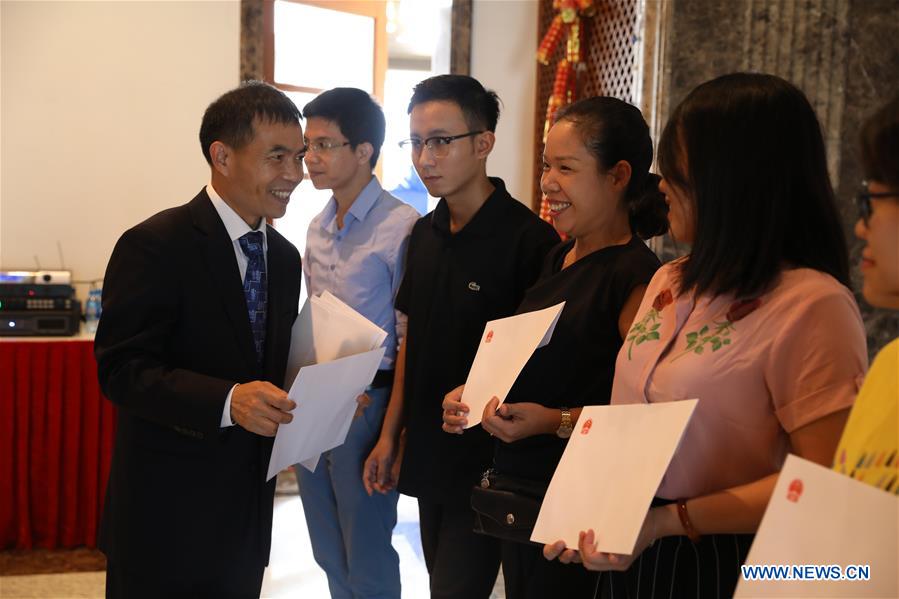
?Peng Shituan (1st L), cultural counselor of the Chinese embassy in Vietnam, presents certificates to the 2018 Chinese Government Scholarship winners in Hanoi, Vietnam, Aug. 13, 2018. The Chinese embassy in Vietnam on Monday held a ceremony to award the scholarships from the Chinese government to 104 Vietnamese. (Xinhua/Wang Di)
by Tao Jun, Bui Long
HANOI, Aug. 16 (Xinhua) -- Many Vietnamese intellectuals said after receiving scholarships from the Chinese government they will spare no efforts to master Chinese advancements, especially in culture and technology, to bring about practical applications or transfer knowledge effectively to younger generations in Vietnam.
"Today I will officially receive a full scholarship from the Chinese government to pursue a doctoral degree in mechatronics at the South China University of Technology in Guangzhou city. I'm deeply impressed by Chinese advancements in robotics, artificial intelligence and automation," Bui Huu Toan, lecturer at the Hanoi University of Technology, told Xinhua on Monday.
Toan is one of 104 Vietnamese who have received scholarships from the Chinese government this year with 56 studying in China to get doctoral degrees and 34 to get master's degrees. The Chinese embassy in Vietnam on Monday held a ceremony to hand over the scholarships to them.
"During my doctoral study in Guangzhou, I am going to make a tiny robot for my dissertation. The robot will be developed for medical purposes. It will be used to manipulate human cells," Toan, a man of small stature with bright eyes, said confidently.
He said that China's robotics industry, which has been the world's biggest industrial robot market, will continue to make leaps and bounds in the coming years thanks to due attention given by the Chinese government. The Vietnamese government is also interested in tapping into the fourth industrial revolution to speed up the transformation of its priority sectors.
"The applications of robots are huge both in Vietnam and China. When I completed my master's thesis, I produced a humanoid robot and it was applied in real life, at a science and technology exhibition in Jiangsu province," Toan said.
The Vietnamese man got his bachelor's degree and master's degree at the Nanjing University of Science and Technology in the Chinese province of Jiangsu. At the exhibition, his humanoid robot worked as a receptionist that spoke Chinese and English, took visitors to booths and provided information about the booths' owners to them.
"The humanoid robot can be used in different places such as hotels, tourist sites, exhibitions and fairs. And this time, after mastering Chinese robot technologies, I will make a tiny robot which can be used in hospitals with the assistance of my Chinese professors and friends," the Vietnamese lecturer said.
"If my robots are not widely commercialized, my knowledge gained during my studies in China will not be wasted, because I will come back to Vietnam to keep on giving lectures about mechatronics engineering to my students," he added, smiling.
Another Vietnamese postgraduate student, Do Thi Thanh Hoa, whose pseudonym is To Hoa, shared similar thoughts and plans after receiving a scholarship from the Chinese government.
"After studying in China, I will come back to Vietnam to work as a lecturer at the Military University of Culture and Arts to convey my knowledge about Vietnamese and Chinese classical and folk music to my students," Hoa, whose soprano singing voice has earned her the nickname "The Nightingale", told Xinhua on Monday.
According to the girl, she studied vocal music in Vietnam, and won the first prize in the classical music category of a prestigious singing contest in the country, but she is keen on further studying folk Chinese music in China because it is very strong, similar to classical music.
"Now I am very happy to receive a scholarship to further study Chinese folk music at the China Conservatory of Music in Beijing. When writing my master's thesis, I will choose a topic about folk songs, folk music of Vietnam and China, maybe about their wonderful characteristics," Hoa said, noting that she got a bachelor's degree in folk music at the Guangxi Arts Institute in 2017.
As a child, she already knew Chinese folk songs through famous Chinese television series, and was impressed by their rhythms and lyrics.
"After returning to Vietnam, I will help my students better understand about Chinese classical and folk music, so we will become little bridges for closer friendship and cultural cooperation between the two countries," Hoa stated.
While both Toan and Hoa have spent years in China, and felt comfortable with the studying and living environments there, mainly thanks to their great integration efforts and the friendliness and helpfulness of Chinese people, Doan Ngoc Chung has been a little bit worried because he has just graduated from the University of Social Sciences and Humanities in Vietnam's Hanoi capital, and have never set foot on Chinese soil.
"Today I am very happy to receive a scholarship from the Chinese government. The scholarship is 3,000 yuan (432 U.S. dollars) a month. But I have never been to China, so I feel a little bit worried about living far away from home," Chung told Xinhua on Monday.
In September, Chung will study literature at the Xiamen University in Fujian province for his master's degree.
Like Hoa, Chung wants to have good command of Chinese culture and then share the knowledge enriched by China with compatriots, contributing to the traditional friendship and comprehensive cooperation between the countries.
"When writing the thesis for my master's degree, I will write about cultural exchanges between Vietnam and China, with a focus on Chinese shamans and shamanism which we call "hau dong" in Vietnamese," said the young man with a dark complexion and a bright smile.
"I like Chinese culture very much, especially Chinese language, calligraphy and paper-cutting art," he added.
Not only Vietnamese postgraduates, but also Vietnamese officials and educators have expressed their deep interest in Chinese culture as well as cultural and educational exchange and cooperation between the two nations.
"I am impressed by Chinese culture and civilization, which is one of the biggest civilizations in the world... I hope that you (Vietnamese receivers of Chinese scholarships) will become bridges for relations between the two peoples and the two countries," Pham Quang Minh, Rector of the University of Social Sciences and Humanities, said at the scholarship-awarding ceremony.
"Education in general and educational cooperation in particular play an indispensable part in the fine relations between Vietnam and China."
"Thanks to mutual understanding about culture, foreign languages and history, the two sides can better foster bilateral ties in other spheres, including economics, politics, security and national defense," Minh told Xinhua after the ceremony.
Pham Chi Cuong, vice head of the International Cooperation Department under the Vietnamese Ministry of Education and Training, said scholarship receivers will become like ambassadors to deepen relations between Vietnam and China and make a contribution to the national development of each country.
According to Peng Shituan, cultural counselor of the Chinese embassy in Vietnam, since the 1950s, the Chinese government has helped Vietnam develop education, and exchanged scholarships.
"The Chinese and Vietnamese governments attach importance to exchanging scholarships to train talented people in spearheaded sectors for national construction and development," Peng stated.