By Xinhua Writer Xu Supei
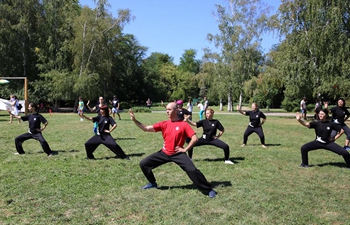
SHIJIAZHUANG, Aug.12 (Xinhua) -- "There is a long, long story between Tai Chi and me," says Jose Gago, 61, a Spanish man who has taught Tai Chi in his hometown for almost 36 years.
On August 8, Jose Gago, the director of the Wushu department in Galicia, attended the 14th International Taijiquan gathering in Yongnian district, Handan city in China's Hebei Province.
Yongnian is the birthplace of the famous Yang and Wu-style Tai Chi. Although the first martial arts school was opened in 1982 in Ourense, Spain, Jose did not make the trip to China until 1994. Since then, he has traveled to China over 20 times to further his study of Tai Chi.
In 1999, Jose met Yang-style Tai Chi master Fu Shengyuan in Spain and started studying his methods.
"Compared with the 24-form Tai Chi, which served as exercise for the sake of public health, Yang-style Tai Chi functions as self-defense," Jose told Xinhua.
For Jose, Tai Chi is not simply a sport. What attracts him most is the Taoist philosophy rooted in Tai Chi. The principles of "softness, slowness, balance and rootedness" are all elements of Taoist philosophy that Tai Chi has drawn upon in its understanding of movement. "[The] human body is a miniature universe. Energy flows in the universe everywhere, like it does in our bodies, " Jose said.
The Spaniard elaborated on his understanding of Taoism with concise words and flowing movements. "The rhythm of Tai Chi is not only echoed by Chinese, but also by people from various races and cultural backgrounds in the world."
He has trained thousands of students in Spain and many of them have won awards in a number of tournaments. "Karate and taekwondo are much easier than Chinese martial arts," Jose said.
In his mind, Chinese Kung Fu is composed of both external and internal practices which create more barriers to reaching a broader audience. "When teaching abroad, Chinese instructors should stand in the Westerners' shoes."
Jose suggested establishing uniform standards and setting up introductory programs for western beginners on the national level. His martial arts school enrolled approximately 150 students in 1982, ranging from children under the age of 5 to senior citizens over 70. Now, it has double that number, especially with a noticeable increase in young students.
"There are over 3 million people practicing Tai Chi in Japan of late," said Fu Qingquan, Fu Shengyuan's successor. Yang-style Tai Chi has evolved overseas in response to people's needs from different countries and districts.
Fu told Xinhua that the local government in Jose's hometown host a number of free Tai Chi community classes and initiate various tournaments. Tai Chi is acting as an important bridge for cultural exchange.
Chinese martial artists went overseas to promote Tai Chi and the western martial enthusiasts like Jose have helped it to spread further.
During this visit to China, Jose went to the tomb of master Fu Shengyuan, who passed away last year. He dressed solemnly in a black suit and knelt in front of the gravestone. "Shifu told me that Tai Chi is like the ocean. Balanced, harmonious and never-ending. This is Tai Chi."