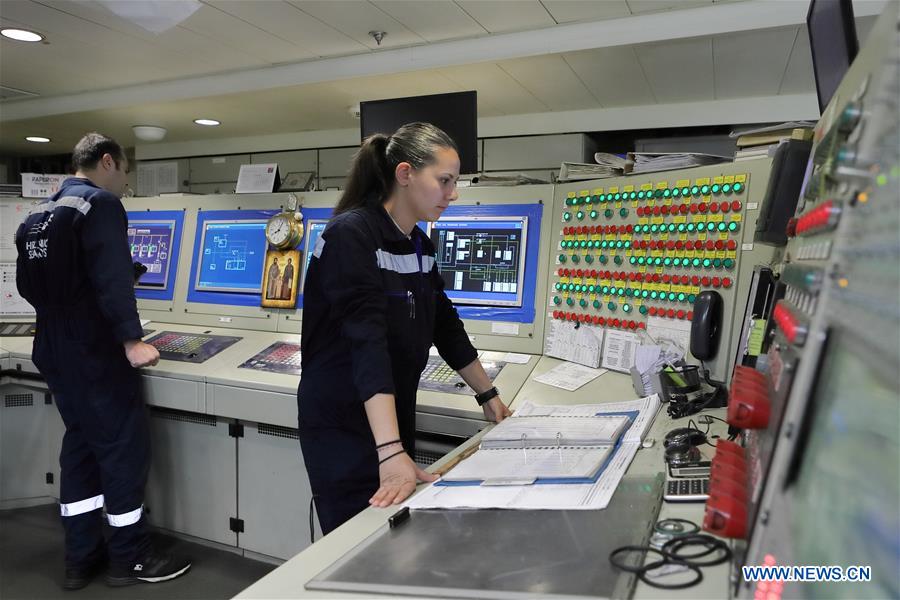
Theano Sileloglou (R) works on the "Mykonos Island" merchant ship at Piraeus port, Greece, May 25, 2018. Theano Sileloglou, 30, has been a member of Hellenic Seaways since 2010. She began her career as a 3rd engineer on "Mykonos Island" ship in 2010 and today she is a 1st engineer. Until recently the ship's engine room was a male-dominated space. (Xinhua/Chris Kissadjekian)
by Natasha Pavlopoulou
ATHENS, May 26 (Xinhua) -- Greece has been a maritime nation since ancient times. Historically though, the maritime industry has been male-dominated and women usually did not pursue a career at sea. There was also an old saying-a superstition from another era that "women are bad luck at sea". Gone is this myth nowadays; still shipping remains one of those industries which have the lowest number of women workforce.
In the last decade, especially due to the economic crisis, the trend is changing. Several young Greek women have tried to find a place in the sun by choosing to study in the country's National Merchant Marine Academy.
Theano Sileloglou, 30, has been a member of Hellenic Seaways since 2010. She began her career as a 3rd engineer on "Mykonos Island" ship in 2010 and today she is a 1st engineer. Until recently the ship's engine room was a male-dominated space.
"I do not come from a naval family. It was a Marine's academy advertisement on television that made me take the decision. I have always loved the sea though. I grew up next to her and I always enjoyed traveling," she told Xinhua on Friday.
As an engineer she covers a wide range of duties: She is responsible, in cooperation with the other ship's first engineer, for any technical issue arising. She handles the engine room, makes decisions about anything that will arise and is responsible for ensuring the proper operation of all mechanical systems and for their maintenance. In short, she guarantees the safety of the crew and by extension of the ship and the passengers.
"When I started working on a boat, things were difficult. The old sailors could not easily accept a woman in their field, since they once considered it a...bad luck. However, in the long run, and with great patience they started to trust me. They accepted me... Besides, all of us are here to make a living," she added.
With the financial crisis looming, a career in the sea seems a good choice for young people. "However, women who want to pursue this profession, have to be armed with a lot of patience, strength and persistence because, unlike men, we still have to prove ourselves," she said.
Amanda Doulgeraki also completed her studies at Merchant Marine Academy of Aspropyrgos in 2012, and had a lot of trouble finding a ship like all the girls in the industry.
After 13 months as a lieutenant in Remi Maritime Corp, she started working for Eletson Corporation which owns and operates one of the world's largest fleets of medium and long range product tankers and one of the few companies that employs female seafarers in Greece, she told Xinhua. She has a Captain's license now and she is hoping to soon use it.
According to the Greek Shipping Ministry data, 1,143 students, including 133 women, passed the entrance exams for the country's Merchant Shipping Academies this year.
Still the overwhelming majority of women who study at the Academies do not graduate. A prerequisite to receive a degree is to travel for several months once the courses end and many students, men and in particular women, find extreme difficulties to secure a position to get their degree, according to a Greek national news agency AMNA.
Statistics for women who work in the sector in Greece are hard to find. According to the Hellenic Statistical Authority, Greek seamen in general who signed on in merchant ships (100 gross registered tonnage (GRT) and over, with Greek and foreign flag) were 15,968 in 2017.
Globally, no matter their achievements in the maritime sector, women make up only an estimated 1 to 2 percent of the world's maritime workforce and around 94 percent of them are working on passenger ships, according to figures of the International Labor Organization.