BEIJING, April 3 (Xinhua) -- What does the Trump administration want? To balance the trade deficit or to protect intellectual property?
The U.S. president mixed up the two problems when he signed a memorandum that could impose tariffs on up to 60 billion U.S. dollars of imports from China, a move against alleged "unfair" intellectual property and technology transfer practices.
If it is about the trade deficit, hitting the high-tech trade won't help reverse the situation. The trade imbalance between the two countries is structural, with China exporting more commodities to the United States while importing more services.
The goods that help build China's trade surplus are mainly household appliances, mobile phones, textiles, clothes and toys, none of which contain many high technologies. But they do reflect an intertwined trade relationship between the two countries against the backdrop of globalization.
For example, it's common to see U.S. companies, in pursuit of lower costs, set up in China assembly plants, which then purchase parts and components all over the world, including from the United States. So experts from both countries suggest it's misleading to track the trade deficit from figures on the surface.
To address the imbalance, both countries should carry out structural reforms rather than just impose tariffs that will hurt American businesses and consumers too.
If it is about intellectual property, wouldn't it be more efficient to talk, given that China has stepped up measures to address this issue and is always open to dialogue?
Many believe the intellectual property accusation is an excuse rather than a real concern.
China, the world's second largest economy, has been striving to upgrade its industrial structure by adopting an innovation-driven development strategy.
It has shown the world its innovation capabilities with a series of cutting-edge technologies. It has launched its first cargo-carrying spacecraft, realized satellite-based distribution of entangled photon pairs over a record distance, displayed its first home-grown large passenger jet, the C919.
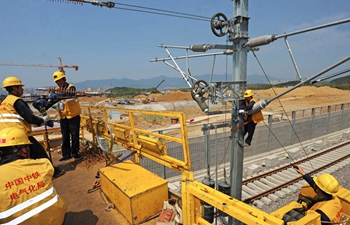
"The four great inventions of modern China" -- high-speed trains, mobile payments, bike sharing and online shopping -- have demonstrated its vitality in applying new technologies in the economy.
The Trump administration, aware of the narrowing gap between the two countries, is worried about Chinese innovation, a key driver of further development. Investigations and tariffs are thus employed as tools to retain the upper hand of the U.S. high-tech industries.
But the U.S. government has neglected China's unprecedented efforts to protect intellectual property rights, a necessary requirement to sustain innovation.
China has been the world leader in applications for invention patents for seven consecutive years. Chinese mainland held about 1.36 million such patents by the end of 2017, according to the State Intellectual Property Office.
The Chinese government in February unveiled guidelines for improving the trial procedures of intellectual property rights (IPR) cases, aiming for higher efficiency, stronger IPR protection and better trial credibility.
In 2016, Chinese courts handled 152,072 IPR cases, up 16.8 percent year on year. Over 3,700 people were arrested and 7,000 prosecuted, according to an IPR protection white paper.
The unilateral measures by the United States will only incur retaliation and drive China to further strengthen its innovation capacity.