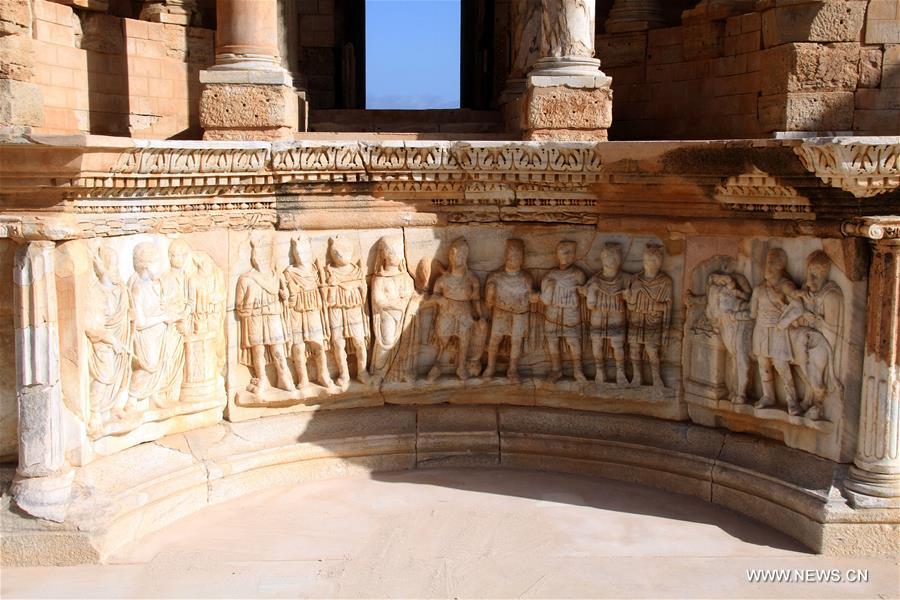
Photo taken on March 13, 2018 shows a view of a historic archaeological site in the western Libyan city of Sabratha. The Libyan historic archaeological sites face multiple threats, mainly thefts and armed conflicts near historic sites. (Xinhua/Hamza Turkia)
by Mahmoud Darwesh, Nawas Darraji
TRIPOLI, March 24 (Xinhua) -- The Libyan historic archaeological sites face multiple threats, mainly thefts and armed conflicts near historic sites.
It is a constant concern for government agencies to develop protection plans and international agreements to secure these sites. This seems elusive in the chaos and political division in Libya.
"Libya's contribution to international agreements is an important way to protect archaeological sites from the threat of theft. Therefore, these agreements must receive attention," Mohammed Faraj, head of Libya's Antiquities Authority, told Xinhua.
"An important agreement was signed recently with the United States, which prohibits the import and export of a collection of antiquities listed and circulated by Washington on all its channels to prevent their smuggling," Faraj added.
Faraj also said that the agreement, if circulated to the countries of the world, would help protect Libyan monuments in a time of great security vacuum "because a large number of looted artifacts are being sold in public auctions in France, Spain, Britain and even in Israel."
"The issue of stolen artifacts is not new. There are international gangs still active in this field, because they choose the right time to display these pieces. Important Libyan artifacts have been smuggled illegally," he said, when asked about the smuggling activities in Libya.
Faraj stressed that the Libyan Foreign Ministry informed the Antiquities Authority of its desire to sign similar agreements with a number of European countries to protect and restore stolen artifacts from Libya.
The United States and Libya later in February signed a five-year bilateral agreement aimed at combating the smuggling and trafficking of Libyan artifacts.
According to a report by the International Council of Museums published last January, the Libyan historic cities under threat are Ghadames, Sabratha, Labda, Sousse and the Acacus Mountains.
The Libyan cities that have suffered the highest amount of artifacts robberies over the past few years were Sousse, Shahhat, Sabratha, Sirte, Bani Walid, Nafusa Mounain, Tocra and Tolmeita.
The ancient city of Sabratha in western Libya, which is classified as a historic world heritage, was damaged by armed clashes in September 2017 between government forces and armed groups involved of human trafficking.
Armed conflicts affect all the Libyan cities in light of the proliferation of weapons. Sabratha was, unfortunately, subjected to several conflicts. The archaeological city was the victim of those clashes.
"The theater was hit several times with shrapnel, missiles and bullets. Some of the city's walls were also hit," Mohamed Abo-Ajela, Sabratha's monument control official, told Xinhua.
The Authority has a plan to repair the damage. The head of the Authority visited the city following the recent conflict and pledged with the representative of Libya to UNESCO to repair the damage once the necessary financial allocations have been made.
"We have qualified Libyan technical teams who are able to repair such damage," Abo-Ajela said, when asked about plans to repair the damage on the monuments.
General Mohammad Emsallem, head of Sabratha's tourist police, said that the recent clashes near the historic city forced all parties to adopt a security plan to enhance the level of protection in the city.
"There is a security plan in coordination with the anti-IS operation chamber and things are under full control," he told Xinhua.
"The human resources are available and we are in contact with the Ministry of the Interior to provide four-wheel vehicles to carry out patrols on an ongoing basis, especially that the city is wide and needs such reinforcements."
Sabratha has witnessed violent clashes in September 2017 between the anti-IS operation chamber of the UN-backed government and and armed groups accused of involvement in human trafficking.
The three-week fighting ended the chamber's forces taking over the city, after 35 people were killed and 200 were injured on both sides, according to medical sources.
The Roman ruins and the famous theater in Sabratha are one of the five Libyan sites included in the UNESCO World Heritage List since 1982.
During the clashes, UNESCO expressed concern about the military action's effect on Sabratha's monuments and called for protection of archaeological sites in compliance with the 1954 Hague Convention for the Protection of Cultural Property in the Event of Armed Conflict.
Khaider Beshir Malek, Chairman of the Libyan Tourism Authority, called on official authorities to pay special attention to Sabratha in particular and archaeological sites in general.
"Sabratha is a city of ancient history since the Roman rule. It represents an important front for Libya throughout the ages. We strongly rely on it to promote tourism again, especially domestic tourism," Malik told Xinhua.
"I call upon decision-makers in Libya to pay attention and develop such world-class archaeological sites, because they are an invaluable world treasure," he said.