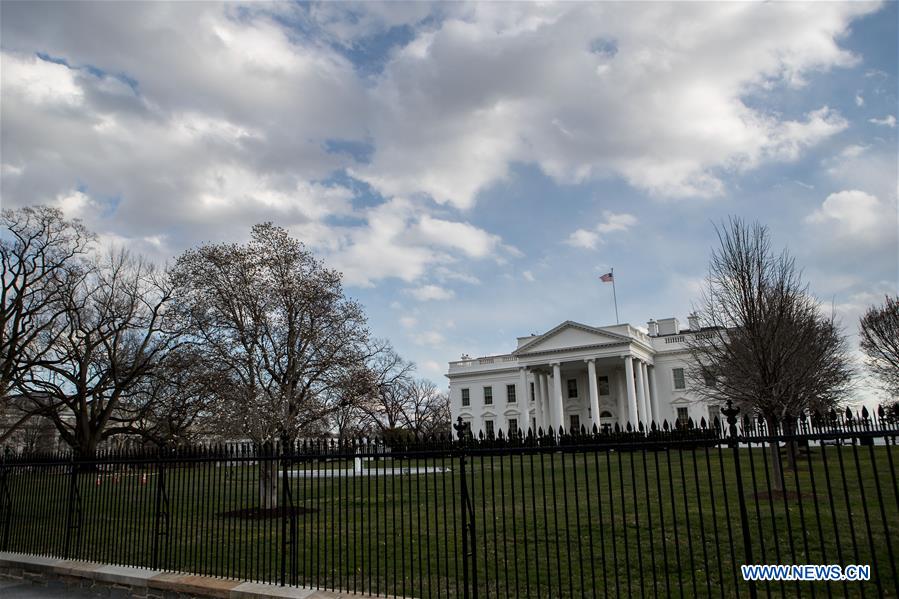
Photo taken on March 8, 2018 shows the exteriority of White House in Washington D.C., the United States. U.S. President Donald Trump on Thursday formally signed proclamations to impose steep tariffs on imported steel and aluminum amid mounting dissent from business groups and trading partners around the world. (Xinhua/Ting Shen)
WASHINGTON, March 15 (Xinhua) -- The U.S. Chamber of Commerce, the largest business lobbying group in the country, on Thursday warned President Donald Trump not to impose sweeping tariffs on Chinese imports, as it would hurt American businesses and consumers.
"The U.S. Chamber would strongly disagree with a decision to impose sweeping tariffs ... We urge the administration to work with the business community to resolve the concerns," Thomas J. Donohue, president of the U.S. Chamber of Commerce, said in a statement.
The U.S. Chamber of Commerce is the world's largest business federation representing the interests of more than 3 million businesses of all sizes, sectors and regions, as well as state and local chambers and industry associations.
"Tariffs are damaging taxes on American consumers," Donohue said, adding that tariffs could lead to "a destructive trade war with serious consequences for U.S. economic growth and job creation."
"The livelihood of America's consumers, businesses, farmers and ranchers are at risk if the administration proceeds with this plan," the statement said.0 Donohue's warning came right after the Trump administration's preparation of a major trade measure aimed squarely at China -- tariffs on 30-60 billion U.S. dollars of annual Chinese imports for China's alleged "unfair trade practices," according to media reports.
"Tariffs of 30 billion dollars a year would wipe out over a third of the savings American families received from the doubling of the standard deduction in tax reform. If the tariffs reach 60 billion dollars, which has been rumored, the impact would be even more devastating," Donohue said.
The Trump administration is mainly targeting a Chinese strategy "Made in China 2025," in which China introduced a comprehensive initiative to upgrade the Chinese industry and dominate sectors including advanced information technology, new energy vehicles and aerospace equipment.
The measures, which could be announced next week, may also include investment restrictions, limits on visas to Chinese researchers and challenges to China's trade practices at the World Trade Organization, according to people familiar with the discussions.
The Trump administration has been alleging that it is making the investment rules "reciprocal," in which the United States would impose similar restrictions on Chinese investment that U.S. firms face in China.
Many U.S. companies, however, argued that limiting Chinese investment could backfire by inviting retaliation from the Chinese and would raise costs for U.S. businesses.
"Tariffs would be incredibly counterproductive," said Josh Kallmer, senior vice president at the Information Technology Industry Council.
"Reciprocity as a concept is fine, but it has to be applied carefully to advance U.S. goals," said Erin Ennis, senior vice president of the U.S.-China Business Council, a trade group.
According to a White House official, the measures are the next part of an administration trade policy aimed at reducing the enormous U.S. trade deficit.
Analyst Daniel Rosen of Rhodium Group said the Trump administration is simplifying the trade deficit issue by blaming foreign governments, and Nicholas Lardy, a senior fellow at the Peterson Institute for International Economics, said the only way to deal with a trade deficit is to increase saving and investment rates.
Chinese Foreign Ministry spokesman Lu Kang said Thursday that China hopes to address bilateral trade issues with the United States in a constructive manner and by making a bigger "cake" of cooperation.
"The two sides have properly resolved their trade differences in a constructive manner over the past 40 years. We believe the two countries can still settle their disputes through friendly negotiations, and we are ready to do so," the spokesman said.