BEIJING, March 14 (Xinhua) -- Five years ago, Zhang Xingying first used Chinese polar-orbiting satellites to detect and measure smog, looking for ways to tackle air pollution.
Now as China makes progress in clearing its skies, the meteorologist hopes the technology can also be shared to brighten the future for all, both at home and overseas.
"Smog may be on the retreat at the moment but remains a problem that cannot be ignored, not only in China but in many other countries," said Zhang, 40, chief scientist of atmosphere composition remote sensing at the China Meteorological Administration (CMA).
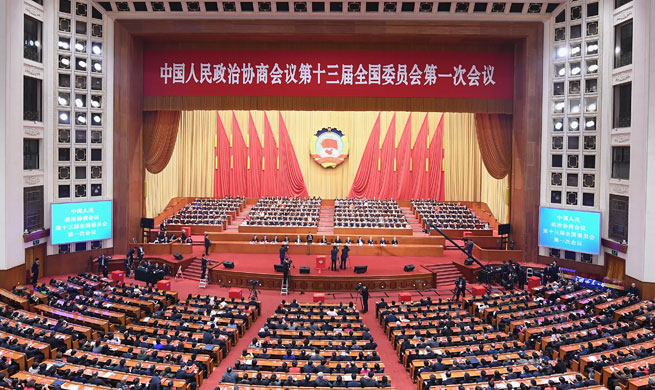
Zhang was speaking on the sidelines of the first session of the 13th National Committee of the Chinese People's Political Consultative Conference (CPPCC), the country's top political advisory body.
As one of China's most important annual political events, the session brings together thousands of CPPCC members from various backgrounds including scientists, officials, entrepreneurs, and religious figures to discuss government policy and put forward suggestions.
Zhang, a political advisor, wants his voice to be heard both in China and beyond. "Our satellites can help more countries with air pollution."
His remarks stem from his research on particulate matter, which he has been involved in since 2001, when the pollutant was largely unknown to the public.
The thick, grey haze that frequently descends on eastern and northern China prompted the government to begin to purify the air, with hunting down polluters the most urgent task.
Zhang and his team modelled the evolution of smog from 1979 to 2013 and then used satellites equipped with ultraviolet sensors to predict long-term trends and variations. "The geostationary orbit satellite Fengyun-4, launched in December 2016, can take clear pictures of the movement of smog that enable us to track the sources of pollution and improve forecasting."
Thanks to numerous scientists like Zhang, the skies over Chinese cities have started to turn bluer, even in winter. The PM2.5 index in Beijing and environs has fallen by 39.6 percent since 2013.
For Zhang, however, the battle is far from over. "From India to Egypt, smog has spread throughout developing countries in the middle of modernization."
China has started to provide other countries with pollutant monitoring services, helping them establish their own remote sensing networks.
The Fengyun series of meteorological satellites cover 42 countries and regions along the Belt and Road. In 2017, the CMA trained nearly 400 specialists and awarded 71 scholarships to meteorological and hydrological students, all from abroad.
"We share the same environment and the same earth. Helping others is actually helping ourselves. That's what 'a community with shared future' means," Zhang said, who is also chief China scientist for an EU-funded remote sensing research program.
The CPPCC session runs almost parallel to the annual session of the 13th National People's Congress, the national legislature. At the "two sessions," political and economic developments, and new policies are reviewed, discussed, adopted or discarded by nearly 3,000 legislators and more than 2,100 political advisors.
Zhang brought a proposal on commercial use of satellite data. "It can be used for a wide variety of purposes, such as steering ocean-going freighters around storms, predicting grain output and in carbon trading."
"Without increased consumption of resources, the green economy will create new growth points for China and the world," Zhang said.