Xinhua file photo?
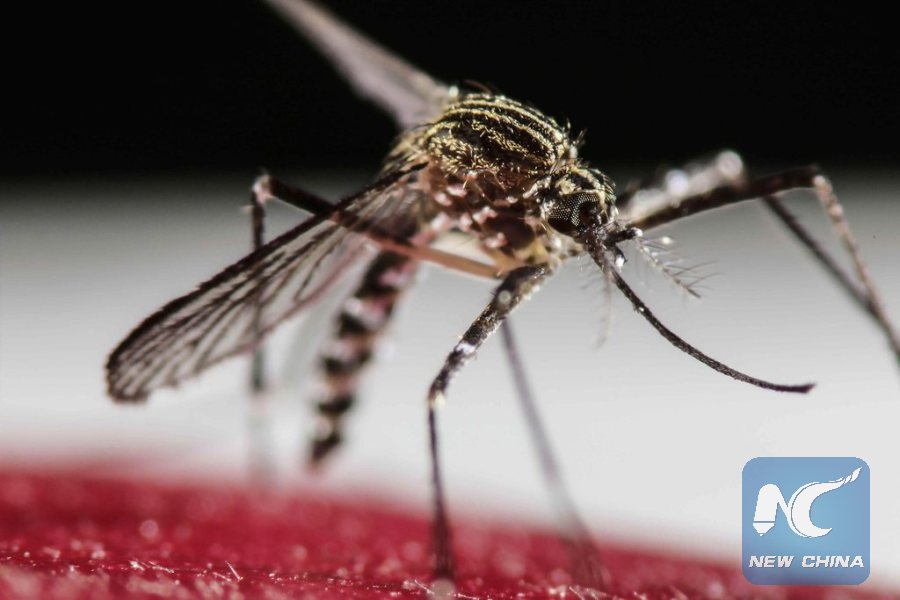
WASHINGTON, Jan. 25 (Xinhua) -- Your grandmother's insistence that you receive more mosquito bites because you're "sweeter" may not be that far-fetched after all.
Researchers reporting in the U.S. journal Current Biology on Thursday showed that mosquitoes can in fact learn to associate a particular odor with an unpleasant sensation.
As a result, they'll avoid that scent the next time.
In other words, those who swat at mosquitoes or perform other defensive behaviors may be abandoned, no matter how sweet.
"Once mosquitoes learned odors in an aversive manner, those odors caused aversive responses on the same order as responses to DEET, which is one of the most effective mosquito repellents," Jeffrey Riffell at the University of Washington in Seattle said in a statement.
"Moreover, mosquitoes remember the trained odors for days," Riffell said.
It had been clear that mosquitoes show obvious preferences for some people over others, and the new study wanted to find out more about how learning might influence mosquitoes' biting preferences.
As a first step, they trained mosquitoes by pairing the odor of a particular person or animal species such as a rat and a chicken, with unpleasant mechanical shocks and vibrations.
Twenty-four hours later, the same mosquitoes were assessed in a Y-maze olfactometer in which they had to fly upwind and choose between the once-preferred human body odor and a control odor.
The mosquitoes avoided the human body odor, suggesting that they had been successfully trained.
Furthermore, the scientists were also able to identify that dopamine is a key mediator of aversive learning in mosquitoes.
Genetically modified mosquitoes lacking dopamine receptors lost the ability to learn.
The findings may have important implications for mosquito control and the transmission of mosquito-borne diseases, according to the researchers.
"By understanding how mosquitoes are making decisions on whom to bite, and how learning influences those behaviors, we can better understand the genes and neuronal bases of the behaviors," Riffell said. "This could lead to more effective tools for mosquito control."