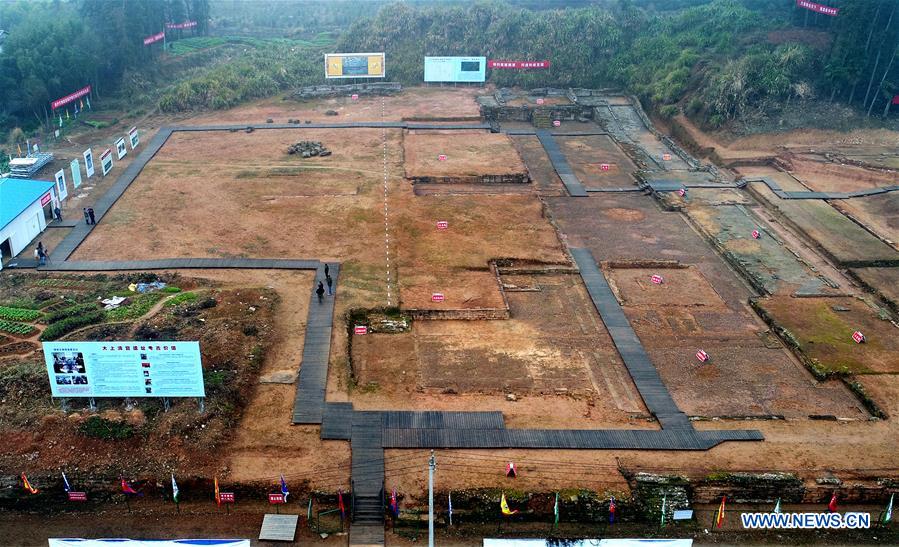
Photo taken on Jan. 21, 2018 shows the site of the Great Shangqing Palace at the foot of Longhu Mountain in Yingtan, east China's Jiangxi Province. After a four-year excavation, archeologists have confirmed the location of the Great Shangqing Palace, which is China's largest Taoist temple built in the Song Dynasty (960-1279) and used continuously until it was destroyed by fire in 1930. (Xinhua/Wan Xiang)
NANCHANG, Jan. 21 (Xinhua) -- After a four-year excavation, archeologists have confirmed the location of China's largest Taoist temple, built in the Song Dynasty (960-1279) and used continuously until it was destroyed by fire in 1930.
Xin Lixiang, an archeologist from China's National Museum and one of China's most authoritative people on the Qin and Han dynasties, said at a press conference on Sunday that the Great Shangqing Palace was a place of worship for a line of emperors throughout Chinese history and was the primary location for the Zhengyi Sect of Taoism.
Archeologists have excavated 5,000 square meters of the palace, which was dedicated to a Chinese Taoist master, located at the foot of Longhu Mountain in east China's Jiangxi Province.
The Zhengyi Sect of Taoism was found by Zhang Daoling (34-156), who was known as Celestial Master Zhang and is believed to have lived and practiced Taoism at Longhu Mountain. Zhang's Taoist temple was originally built on top of the mountain during the Han Dynasty (202 B.C -220 A.D.).
During Song Dynasty, a Taoist palace dedicated to Zhang was built at the foot of the mountain, and was later expanded and became an imperial palace for Taoist practice through Yuan Dynasty (1271-1368).
The palace was destroyed in a fire in 1930.
In 2014, workers building a scenic area at the mountain found a stele with characters marking a major renovation of the palace during the rein by Eperor Jiaqing (1760-1820) in Qing Dynasty. The provincial cultural relics bureau reported the finding to the State Bureau of Cultural Relics who approved the excavation.
Archeologist said it is the largest excavation of a Taoist site in China. In addition to the core palace excavation, archeological surveys have been carried out over a 30-square-km area to ascertain the original palace structure.
A trove of pottery and porcelain as well as building materials were unearthed, including glazed tiles from the temple's ancient paintings.
Archeologists believe that the ruins of the palace are worthy of an application for world heritage classification in the future.