by Quan Xiaoshu, Qu Ting, Cao Pengyuan
BEIJING, Jan. 16 (Xinhua) -- The ruins of an ancient tripartite-city, known as Sanlian City, in midwest Mongolia's Khermental City, demonstrates that the Xiongnu tribe used to perform religious ceremonies and hold alliance meetings there.
The Xiongnu was a nomadic tribe that made its first appearance in northern Eurasia in the third century B.C., migrating westward in the second century before vanishing in the fifth century.
The new findings, as a result of the joint excavation by Chinese and Mongolian archaeologists since 2014, was selected as one of the most important joint archaeological discoveries of 2017 by the Chinese Academy of Social Sciences (CASS) Tuesday.
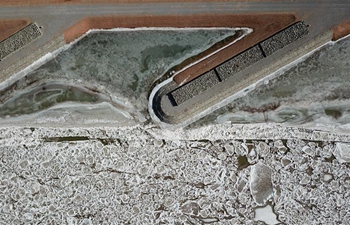
Over the years, the enigma around the Xiongnu has drawn attention from historians across the world. Being a rare Hun city model, the tripartite-city, adjacent to the Tamir River in the south and the Orhon River in the east, comprises three sub-cities all built in the same structure and rectangular shape.
Archaeologists believe that the city existed in a period between the third century B.C. to the first century, but cannot precisely confirm when they first appeared and disappeared.
They started excavating the central pedestal in the central city in 2017, finding that there might once have existed grids of large columns or cloisters built for ritual ceremonies.
The red-sand pedestal is 35.8 meters in length and 2.75 meters above the ground. Yet, its rooftop structure is unclear. It is connected with smaller southern pedestals via several long paths.
"It substantially differs from contemporaneous Han Dynasty (202 B.C. -- A.D. 220) pedestals in forms and structures," said Song Guodong, executive head of the Chinese side of the joint excavation team.
But archaeologists have not found heating facilities, ashes or any other life remains in the city, and thus can almost exclude the possibility that it was a place for day-to-day residence and work.
Written historical books in ancient China recorded that the Xiongnu used to build religious sites along the basin of the Orhon River for their religious conventions, such as offering sacrifices to the god of heaven three-times-a-year. Later, the chief of the Xiongnu also convened meetings on state affairs at the sites by the opportunity of these religious ceremonies, with horse racing and camel riding as an amusement.
Located in the same river basin, the tripartite-city, the largest and best preserved site of the Xiongnu in Mongolia, is believed to show ritual features very similar to historical records.
"In the past, most of our global peers specializing in ancient nomadic peoples, like the Xiongnu and Uyghur, mainly focused on tomb excavation and research, and their studies were fragmentary," said Wang Wei, director of the Archaeology Department of CASS.
The cooperation between the archaeologists of the two countries has shed new light on the studies of nomadic cultures, Wang said.
In 2018, more archaeological teams from China, including teams from the National Museum of China, Henan Provincial Institute of Cultural Heritage and Archaeology, Renmin University of China and Jilin University, will go to the ruins and work with their Mongolian counterparts.