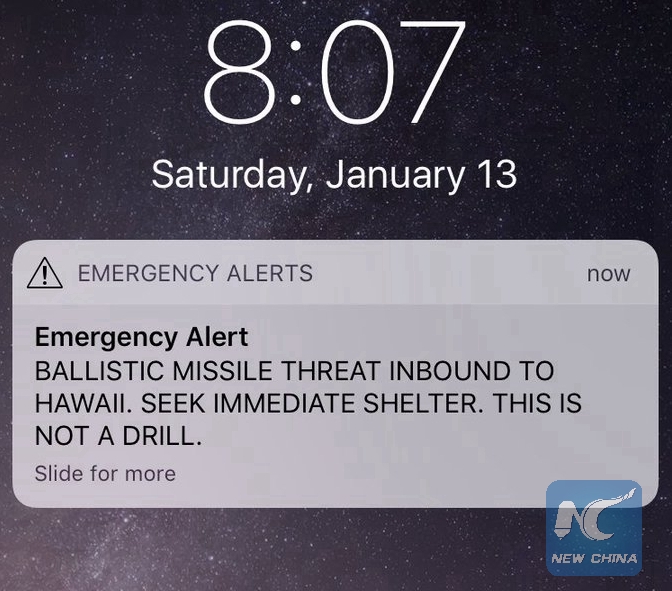
A screen capture from the Twitter account of U.S. Congresswoman Tulsi Gabbard shows a missile warning for Hawaii, the United States. on January 13, 2018. (Xinhua)
SAN FRANCISCO, Jan. 15 (Xinhua) -- The U.S. state of Alaska said Monday that it will not commit the same error by Hawaii, a U.S. pacific state, which sent a missile attack alert in error last Saturday that caused huge panic among the pubic.
Alaska has a more reliable system to warn residents of an incoming nuclear or other long-range missile attack, Alaska's Anchorage Daily News quoted officials of the Alaska Department of Military and Veterans' Affairs, as well as the state's Department of Homeland Security and Emergency Management as saying.
Mike Sutton, director of Alaska Homeland Security and Emergency Management, said the state emergency operations center is staffed during the normal workday, while an on-call duty officer is equipped with a cellphone and laptop around the clock.
The center would alert television and radio stations and also send text messages to cellphones across Alaska in the event of a missile attack, he said.
Laurie Hummel, commissioner of the Alaska Department of Military and Veterans Affairs, said Alaska residents would not receive an alert of a missile attack in error because Alaska's system has built-in checks which Hawaii is lacking.
She said Hawaii's system was too simple and it requires a second employee to sign off on a real alert.
"We don't have a simple button that you would hit, and it could be the wrong button," said Sutton, echoing Hummel's comment on Hawaii's alarming system.
"We have to manually create the message, type in a password, click multiple buttons and then, before you transmit, the system is going to ask the operator to type 'yes' before you are allowed to actually proceed," explained Hummel.
Last Saturday, an employee in Hawaii mistakenly sent an alert of a missile attack that went to cellphones all over the islands and caused fear and despair among the public before it was cancelled 38 minutes later.