GUIYANG, Jan. 9 (Xinhua) -- Nuo opera, a religious ritual to ward off evil spirits, has transformed fortunes in southwest China's Guizhou Province.
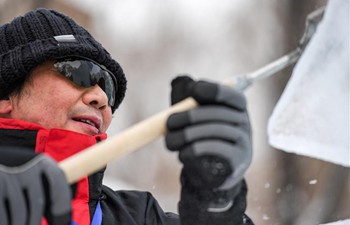
In rural Dejiang County, Wang Guohua teaches the carving of ferocious Nuo opera masks to several apprentices.
"I was not respected by other villagers who did not see carving masks as a decent job," Wang, 52, said. "Now, it is big business."
The Nuo ritual has been practiced for thousands of years. Sacrifices and ceremonies paid tribute to ancestors, gods and goddesses while exorcising demons. It spread among people of various ethnicities along the Yangtze and Yellow river valleys and southwestern areas. Nuo rituals were widely performed at Lunar New Year holidays to expel evil spirits.
Accompanied by drum and gong, Nuo performers equipped with whips, dance to mysterious tunes. They wear colored masks -- black, white and red -- bearing varied expressions -- amiable, ferocious or fearful. In recent decades the ceremony has become little more than a theatrical performance.
In Wang's workshop, wood, tools and masks of all kinds are strewn everywhere. Wang has been carving masks for 36 years, creating more than 4,000 masks.
Guizhou is famous for its variety of Nuo opera. Wherever there is a performance in an outlying village, farmers trek dozens of kilometers along hillside paths to watch. Though some elderly folks are still in awe of the Nuo dancing "gods," few today fully understand the ritual.
SERIOUS BUSINESS
Guizhou is the frontline of the poverty-relief campaign with more than 3.7 million people living under the poverty line. Many men in Guizhou have left home to seek work, leaving the elderly, women and children behind.
When Wang started making masks, no one understood why he did not find a "decent job," not even his wife Qin Zhichan.
"Rural people were supposed to work in the fields instead of doing 'business,' and when I married into his family from the neighboring village, we had financial difficulties," Qin recalled. "I felt I could not depend on him and we quarrelled a lot."
The wheel of fortune did not turn for Wang until 2003, when an international seminar on Nuo culture was held in the county. Foreigners were instantly drawn to Wang's masks.
"I made 2,000 yuan (300 U.S. dollars) with my masks at that time," Wang said. With the money, he bought a color TV. Suddenly, his wife and the other villagers started to take his business seriously.
With his amazing craftsmanship, business soared. In 2006, he was honored as "master of Nuo masks in Guizhou" and took his masks to exhibitions in France, the Netherlands, Belgium and Japan. In 2010, he registered a company, and recruited some apprentices.
The mask business easily took them out of poverty. Lyu Changhong, once a poor villager, was one of the first apprentices. In Wang's studio, he can make 200 yuan by carving a mask, 30 yuan for polishing a mask and 15 yuan for coloring. Lyu left poverty behind two years ago.
FACING THE FUTURE
In the past three years, Wang has made more than 2 million yuan and bought two cars, but he cares more than just money. He has memorized more than 200 mask models and can create them on the spot. He has also made his own variations, reinventing the masks.
"He is always thinking about new, different masks," said Zhou Guozai, another of Wang's apprentices. "Making masks seems to more important to him than eating meals."
Wang is very picky about the materials he uses.
"We usually choose poplar trees from local mountains. They are not only delicate, but are believed to have a deterrent effect on evil spirits," Wang said.
"Making a mask is not easy. There are more than 20 steps, and everything is done by hand. Each stroke of the chisel is important," he said.
In Wang's "spare" time, he goes to a local school to teach pupils how to carve masks, just to "pass on the tradition." He also helped establish a gallery of Guizhou's ethnic handicrafts.
"We need to find a way to attract young talent to the craft," Wang said. "Only in this way can we guarantee the survival of the tradition."