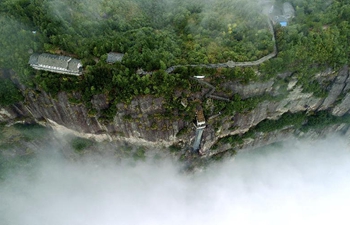
TAIYUAN, Jan. 8 (Xinhua) -- With winter temperatures nearing minus 20 degrees Celsius, a green belt of pine trees stands out on what used to be barren land near the bay of Qiankunwan in north China's Shanxi Province.
The Yellow River, China's second-longest waterway, traverses the province, making a giant "U-turn" at Qiankunwan in Yonghe County, before flowing southward and finally into the sea.
"Of the 99 turns of the Yellow River, Qiankunwan is the most beautiful," goes a local saying.
Bai Xinmin, former head of the forestry bureau of Yonghe County, knows the beauty did not come easily, but was due to generations of afforestation work on the barren land near Lyuliang Mountain.
Lyuliang Mountain is on the edge of the Loess Plateau, which was plagued by chronic soil erosion in the last century, resulting in ecological imbalance. Tens of millions of tonnes of mud and sand washed into the Yellow River, making up most of the silt that gave the river its name.
"A bowl of water scooped from the river contained half a bowl of sand and mud 20 years ago," Bai recalled, adding that soil erosion had affected farming yields, making it hard for local farmers to make ends meet.
Three years after China piloted a project to plant trees on former farmland, Yonghe County started afforestation work on the mountain in 2002.
"While growing the trees, we had to tie ourselves to mountain rocks to avoid falling down the mountain," said Bai.
To keep the trees alive, local farmers had to bring barrels of water up the mountain for irrigation.
Forest coverage in the county had quadrupled to nearly 27,000 hectares by 2016, meaning every resident in the county has planted nearly 0.3 hectare of trees on average over the past 15 years.
The green mountain adorned by the Yellow River has drawn tourists as well as investment.
Figures show the fiscal revenue of the county surged more than 30 times to 158 million yuan (24 million U.S. dollars) in 2016.
The provincial government has combined the afforestation project with the battle against poverty, encouraging poor families to plant trees to earn a salary from the government.
In an area near Lyuliang Mountain in Linxian County, the largest impoverished county in the country, more than 20,000 hectares of trees were planted on formerly cultivated land last year.
The county government has organized nearly 300 cooperatives specializing in afforestation and poverty alleviation, with more than 11,000 people from poor families recruited for tree planting.
"By planting trees nine hours a day for six months, my husband and I made more than 30,000 yuan in 2017," said Du Guixiang, 60, from the county's Lijiawan Village.
China has prioritized the environment, with afforestation one of its major projects.
A report delivered at the 19th National Congress of the Communist Party of China last October said China would expand the project to plant trees on formerly cultivated land.
According to the State Forestry Administration, the country aims to cover 667,000 hectares of farmland in trees every year by 2020.
Over the past five years, 23 impoverished counties have spent 2.14 billion yuan to plant 380,000 hectares of trees in the Lyuliang Mountain area, with the forest coverage rate reaching more than 14 percent.
By 2020, the province plans to further expand forest coverage to 26 percent.
"Lyuliang Mountain, formerly known for soil erosion, has become an example for ecological rehabilitation," said Zhang Jianguo, Party secretary of Linxian County.