BEIJING, July 11 (Xinhua) -- Recent years have seen China's increased involvement in global governance, either by strengthening partnerships or voicing proposals at multilateral events.
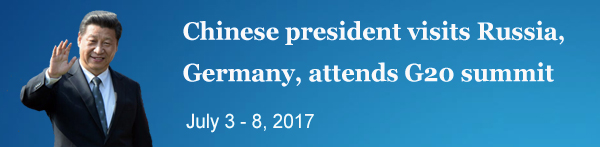
President Xi Jinping's week-long trip to Russia and Germany, including attendance at the G20 summit in Hamburg was the latest example.
In his visit to Russia, the two countries strengthened consensus on policy and strategy over a range of global issues, including synergy between the Belt and Road Initiative and Russia's Eurasian Economic Union.
The bilateral relations, on the basis of non-alliance, non-confrontation and not targeting third countries, serve as a paradigm for a "new type of relations between major countries."
In his third trip to Europe in less than seven months, Xi's visit to Germany has not only deepened ties between the world's second and fourth largest economies, but also China's overall cooperation with Europe.
At the G20 summit in Hamburg, Xi called on leaders to work together on interconnected growth for shared prosperity and build toward a global community with a shared future.
Experts said Xi's solutions showed long-term vision and feasibly opened more spaces for global economic growth during times of world turmoil.
Thomas Heberer, a China watcher from Duisburg-Essen University, said Xi had assumed "the major role" in pushing a cooperative and open world economy.
While the influence of some countries has decreased, experts said Germany and China together have been significant in pushing forward global goals under G20.
The global economy has seen its best performance since the 2008 financial crisis, yet the foundation for future growth remains weak. At this time, it is crucial for countries, developed or emerging, to strengthen macroeconomic policy coordination and forestall risks in financial markets, said Cheng Guoqiang, a researcher with the Development Research Center of the State Council.
"China aims to tackle the problems of inequality, exclusivity and inefficiency in the previous globalization process and provide better global governance products for the world," said Fan Yongpeng, an associate professor with the China Institute of Fudan University.
Xi has consistently shown China's commitment to advocating an open economy, free trade and inclusive growth.
At the G20 Hangzhou summit in September last year, Xi championed a Chinese remedy for the febrile world economy -- strengthened coordination of macroeconomic policies and joint efforts to boost world economic growth and maintain financial stability.
In January, Xi, as a keynote speaker at the World Economic Forum in Davos, Switzerland, offered a defense of globalization and signaled China's commitment to play a bigger role on the world stage.
In May, Xi called on building the Belt and Road into a road of peace, prosperity, opening up, innovation and connecting different civilizations, while delivering a keynote speech at the Belt and Road Forum for International Cooperation in Beijing.
China does not preach - it walks the talk. It has strived to honor its promises through concrete action.
The country has taken the lead in setting up new multilateral platforms such as the Asian Infrastructure Investment Bank and the New Development Bank. It is advancing the Belt and Road Initiative as a way to stimulate global economic growth and make it more inclusive.
By linking countries and regions that account for about 60 percent of the world's population and 30 percent of global GDP, the initiative is a perfect example of China sharing its own wisdom and solutions for global growth and governance.
So far, 68 countries and international organizations have signed agreements with China on Belt and Road cooperation. Total trade between China and Belt and Road countries exceeded 3 trillion U.S. dollars between 2014 and 2016, and Chinese investment in these countries surpassed 50 billion dollars.
With China set to host the 2017 BRICS Summit in Xiamen in September, Fan said the world needed to hear more of China's sober, rational and constructive voice in global governance.
Though growing in strength, China is still in essence a developing country, and will, as always, stand up for the interests of developing nations.
China holds that supporting Africa's development is conducive to encouraging balanced and inclusive world economic growth.
During his speech at the Hamburg summit, Xi called on G20 members to jointly implement the initiative agreed at last year's summit in Hangzhou, on supporting the industrialization of Africa and the least developed countries.
As a responsible country, China has taken a lot of concrete action to put its proposals into practice, said Wang Lei, a researcher on BRICS cooperation with Beijing Normal University. "Such actions are conducive to world peace and development, and especially enable other developing countries to share the benefits of China's reform and opening up."