




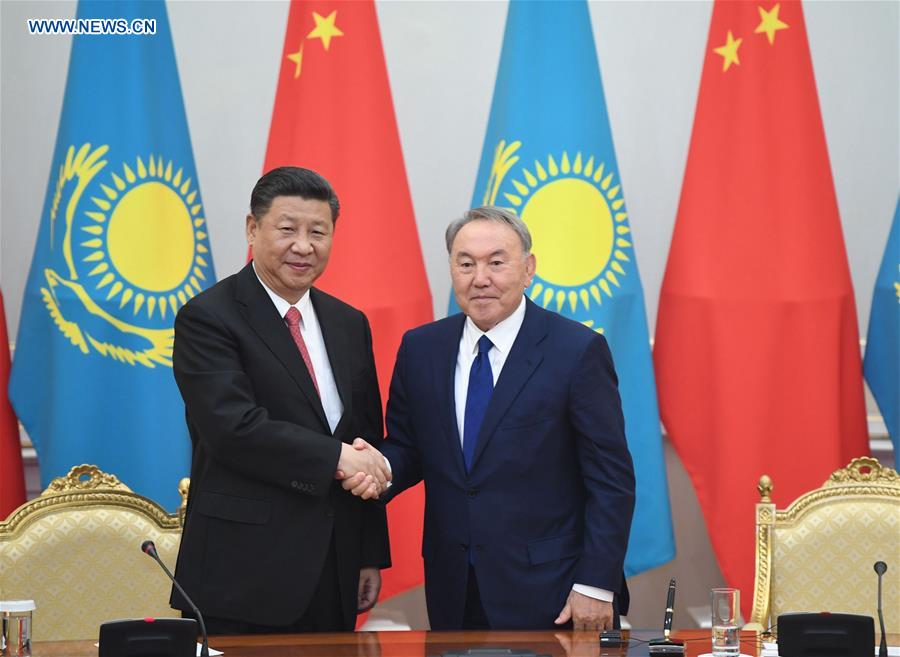
Chinese President Xi Jinping (L) shakes hands with his Kazakh counterpart Nursultan Nazarbayev as they signed a China-Kazakhstan joint statement and witnessed the inking of a series of bilateral cooperation documents after their talks in Astana, Kazakhstan, June 8, 2017. (Xinhua/Wu Xiaoling)
ASTANA, June 9 (Xinhua) -- Back in 2013 in Kazakhstan, Chinese President Xi Jinping first proposed the initiative of the Silk Road Economic Belt, starting the process of Belt and Road (B&R) cooperation.
Four years later, when Xi paid his third state visit to the Central Asian country, the B&R Initiative has developed from a proposal to actions, and from a concept to practice.
On Thursday in Astana, Xi held talks with his old friend, Kazakh President Nursultan Nazarbayev, to take stock of the achievements the two countries have made since they forged diplomatic ties 25 years ago and to chart the course for future cooperation in all areas -- especially in seeking synergy between the B&R Initiative and Kazakhstan's new economic policy of the "Nurly Zhol," or "Bright Path."
It has been the 16th meeting between the two leaders since 2012.
Noting that the political mutual trust has reached an unprecedented height, Xi said China is willing to build "a stronger community of shared interests and shared future" with Kazakhstan, and hopes the two countries can be "good neighbors, friends and partners forever."
For his part, Nazarbayev lauded the significance of the B&R Initiative, pledging to actively participate in B&R cooperation in areas including cross-border transportation, production capacity, industrial parks, finance, agriculture, people-to-people and cultural exchanges.
The two countries will focus on aligning the construction of the New Eurasian Land Bridge and the China-Central and Western Asia Economic Corridor with the Kazakh strategy of building an international logistics corridor.
Meanwhile, they will join efforts in connecting the international production capacity cooperation with Kazakhstan's push for industrialization, sharing China's transportation advantages on land and by sea with the world's biggest landlocked country, and linking China's "digital Silk Road" initiative with the "digital Kazakhstan" strategy.
According to a joint statement signed between the two sides, China and Kazakhstan also agreed to develop more international cargo train services, starting from China via Kazakhstan to Central Asia, Europe and Gulf countries and to effectively lower logistic cost, making railway freight a major solution for cargo transportation between Asia and Europe by 2025.
To showcase the B&R cooperation achievements between the two countries, the two heads of state inspected via videolink the logistic center in China's eastern city of Lianyungang and a dry port in Horgos, a city of China's Xinjiang Uygur Autonomous Region bordering Kazakhstan.
Both cities are key hubs of the Europe-bound China Railway Express and the New Eurasian Land Bridge. In 2016, more than 1,200 trains transited through Kazakhstan, with rail freight handled by the two countries' railways reaching 8.2 million tons and the number of freight containers rising by more than two-fold.
The two leaders praised this cross-border transportation project as a model in their B&R cooperation, saying it will benefit the economy and people of the countries along this route.
Xi's visit to Kazakhstan came only less than a month after China held in Beijing the Belt and Road Forum for International Cooperation, which was attended by leaders from 29 countries, as well as the heads of the United Nations, International Monetary Fund and World Bank.
The countries represented at the May 14-15 forum agreed to work more closely together to synergize development strategies for greater complementarity and common development.
At the forum, China pledged more financial support for the B&R construction, including an additional 100 billion yuan (about 14.5 billion U.S. dollars) to the Silk Road Fund, and assistance worth 60 billion yuan (8.8 billion dollars) in the coming three years to developing countries and international organizations participating in the initiative.
"The international situation is undergoing profound and complex changes. The world economy is slowly recovering amid deep-going readjustment. Global development remains a daunting challenge. In this context, the building of the Belt and Road brings us unprecedented historic opportunities," Xi wrote in a signed article in the Kazakh newspaper Aikyn Gazeti ahead of his visit to Kazakhstan.
Also Thursday, Xi met with Afghan President Ashraf Ghani Ahmadzai and Russian President Vladimir Putin in Astana, all pledging to boost B&R cooperation.
On Friday, the Chinese president will attend the annual Shanghai Cooperation Organization summit and the opening ceremony of Expo 2017 in Astana.
Accompanied by Nazarbayev, Xi visited the China Pavilion at the Expo on Thursday afternoon.

