



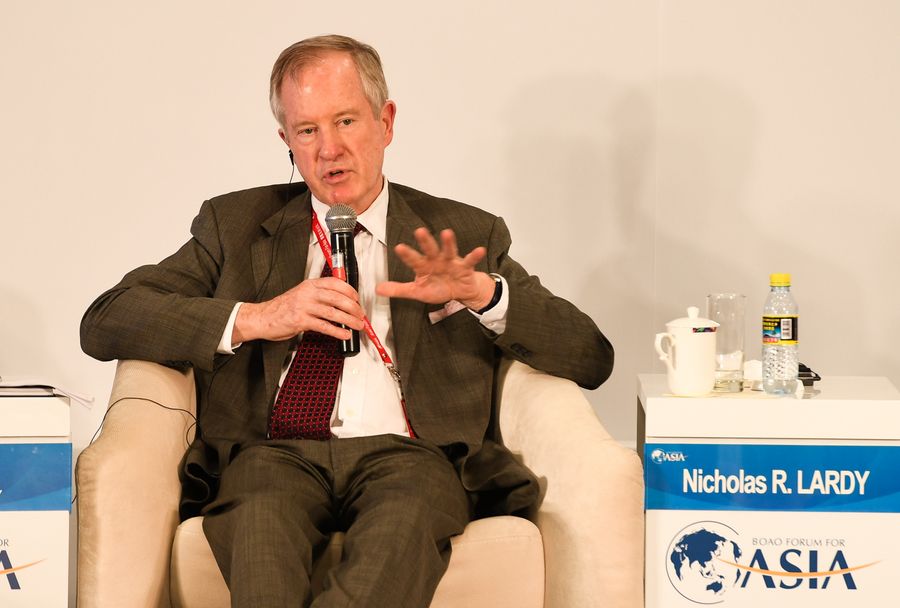
File photo: Nicholas R. Lardy, senior fellow at the Peterson Institute for International Economics, speaks at the Boao Forum for Asia Annual Conference 2018 in Boao, south China's Hainan Province, April 11, 2018. (Xinhua/Yang Guanyu)
U.S.-China economic decoupling is not beneficial to the United States, an expert said.
NEW YORK, Dec. 7 (Xinhua) -- Decoupling from China will cost the United States opportunities for development and leave it disjointed from the rest of the world, experts and scholars have said.
Speaking here at a panel discussion organized by China Institute, Nicholas R. Lardy, senior researcher at the Peterson Institute for International Economics, noted that there were few signs of major economies decoupling from China, as data shows that foreign direct investment (FDI) to China continues to grow strongly.
"Thousands and thousands of new foreign firms are being established every month," said Lardy, adding that many companies are reinvesting their profits in China as they see the Asian nation as a strong market.
In the January-August period, FDI expanded 6.9 percent year on year to 604 billion yuan (about 85.36 billion U.S. dollars). FDI inflow grew 3.2 percent year on year to 89.26 billion dollars, data from the Ministry of Commerce showed.
These gains were hard-earned given the global FDI flows had declined for three consecutive years. In 2018, global FDI went down 13 percent, and developed countries saw a record low FDI inflow since 2004, according to the World Investment Report 2019 published by the United Nations Conference on Trade and Development.
Noting that the United States has never been a big investor in China, Lardy pointed out that most of China's foreign investments come from other places.
"If there is decoupling, it's going to be decoupling of the United States from the rest of the world, because other countries are not decoupling from China," Lardy said.
The economic decoupling between the United States and China is not beneficial to the United States, Wei Shangjin, professor of finance and economics at Columbia University, also said.
Contrary to the notion that China is the most important economic competitor to the United States, Wei, also former chief economist of the Asian Development Bank, said that the two economies are well integrated with each other.
Economic decoupling from China means that the United States would see an increase of costs and loss in competitiveness, Wei said. ■
