中文字幕网伦射乱中文-超清中文乱码字幕在线观看-亚洲v国产v欧美v久久久久久-久久性网-手机在线成人av-成人六区-国产人与zoxxxx另类一一-青青草国产久久精品-蜜桃av久久久一区二区三区麻豆-成人av一区二区免费播放-在线视频麻豆-www爱爱-成人免费看片视频-性欧美老肥妇喷水-五月99久久婷婷国产综合亚洲-亚洲最色-各种含道具高h调教1v1男男-91丨porny丨国产-国产精品无码专区在线观看不卡-大香伊人

 
American, Chinese scientists make world's fastest man-made rotor
                 Source: Xinhua | 2018-07-21 02:38:34 | Editor: huaxia

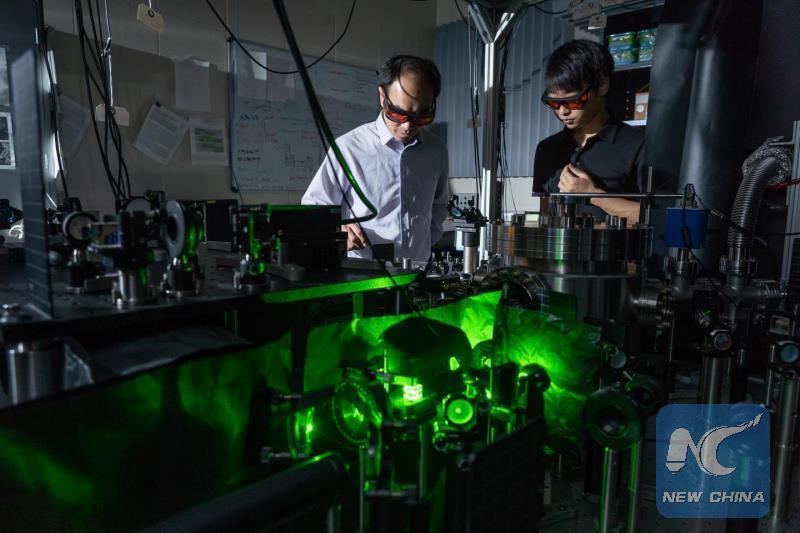
Tongcang Li and Jonghoon Ahn levitate a nanoparticle in vacuum and drive it to rotate at high speed, which they hope will help them study the properties of vacuum and quantum mechanics. (Credit: Purdue University/Vincent Walter)

WASHINGTON, July 20 (Xinhua) -- American and Chinese researchers have created the fastest man-made rotor in the world, spinning at more than 60 billion revolutions per minute or over 100,000 times faster than a high-speed dental drill.

They described in a study published on Friday in the journal Physical Review Letters a tiny dumbbell from silica they synthesized.

They levitated the dumbbell in high vacuum using a laser. The laser can work in a straight line or in a circle: when it's linear, the dumbbell vibrates, and when it's circular, the dumbbell spins.

A spinning dumbbell can function as a rotor, and a vibrating dumbbell can function like an instrument for measuring tiny forces and torques, known as a torsion balance, according to the study.

"This study has many applications, including material science," said Li Tongcang, an assistant professor of physics and astronomy at Purdue University, who collaborated with researchers from Peking University, Tsinghua University and the Collaborative Innovation Center of Quantum Matter in Beijing.

Those rotating devices were previously used to discover things like the gravitational constant and density of Earth, but the researchers hoped that as the devices became more advanced, they would be able to study things like quantum mechanics and the properties of vacuum.

"People say that there is nothing in vacuum, but in physics, we know it's not really empty," Li said.

"There are a lot of virtual particles which may stay for a short time and then disappear. We want to figure out what's really going on there, and that's why we want to make the most sensitive torsion balance."

By observing this tiny dumbbell spin faster than anything before it, Li's team may also be able to learn things about vacuum friction and gravity.

Understanding these mechanisms is an essential goal for the modern generation of physics, Li said.

Back to Top Close
Xinhuanet

American, Chinese scientists make world's fastest man-made rotor

Source: Xinhua 2018-07-21 02:38:34

Tongcang Li and Jonghoon Ahn levitate a nanoparticle in vacuum and drive it to rotate at high speed, which they hope will help them study the properties of vacuum and quantum mechanics. (Credit: Purdue University/Vincent Walter)

WASHINGTON, July 20 (Xinhua) -- American and Chinese researchers have created the fastest man-made rotor in the world, spinning at more than 60 billion revolutions per minute or over 100,000 times faster than a high-speed dental drill.

They described in a study published on Friday in the journal Physical Review Letters a tiny dumbbell from silica they synthesized.

They levitated the dumbbell in high vacuum using a laser. The laser can work in a straight line or in a circle: when it's linear, the dumbbell vibrates, and when it's circular, the dumbbell spins.

A spinning dumbbell can function as a rotor, and a vibrating dumbbell can function like an instrument for measuring tiny forces and torques, known as a torsion balance, according to the study.

"This study has many applications, including material science," said Li Tongcang, an assistant professor of physics and astronomy at Purdue University, who collaborated with researchers from Peking University, Tsinghua University and the Collaborative Innovation Center of Quantum Matter in Beijing.

Those rotating devices were previously used to discover things like the gravitational constant and density of Earth, but the researchers hoped that as the devices became more advanced, they would be able to study things like quantum mechanics and the properties of vacuum.

"People say that there is nothing in vacuum, but in physics, we know it's not really empty," Li said.

"There are a lot of virtual particles which may stay for a short time and then disappear. We want to figure out what's really going on there, and that's why we want to make the most sensitive torsion balance."

By observing this tiny dumbbell spin faster than anything before it, Li's team may also be able to learn things about vacuum friction and gravity.

Understanding these mechanisms is an essential goal for the modern generation of physics, Li said.

010020070750000000000000011100001373384611