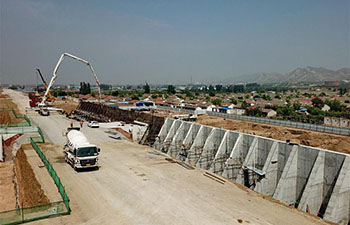
THE HAGUE, June 13 (Xinhua) -- Trade between the countries involved in the Belt and Road Initiative (BRI) accounts for more than a quarter of world trade, so better connections and the lower trade costs that come with them could have a significant global impact, according to an analysis of the Amsterdam-based global bank ING.
"A halving in trade costs between countries involved in the BRI could increase world trade by 12 percent. Countries in Eastern Europe and Central Asia stand to benefit most," said the ING report released earlier this month, which focuses on the BRI as a large and long-term program of investment in transport infrastructure across Asia and Europe.
Rail services between China and Europe have increased since the announcement of the BRI in 2013 and a portfolio of ports are being developed with highly efficient terminal operations and connections to overland transport networks, said the report.
Apart from infrastructure, there are also schemes which help smooth the passage of goods such as the "smart and secure trade lane" project operating in 16 ports -- a strategy for enhancing the customs co-ordination between BRI countries, and other plans aiming to achieve harmonisation of standards and mutual recognition certification, it said.
Already, more accessible rail transport offers a new way to transport goods quickly between China and Europe. "As trail transport becomes more accessible, importers and exporters can use rail transport when previously they have only had the options of air and sea transport," said the report.
"Faster delivery frees up working capital and reduces capital costs, and rail transport also offers a much greener alternative to air transport for the most time-sensitive trade flows."
Since trade between Asia and Europe accounts for 28 percent of world trade, the ING analysis believed that making those trade flows easier has a large potential impact. In its investigation using three scenarios, the report assumed that the BRI will in the long run lead to a 50 percent fall in trade costs between a different set of countries.
"When trade costs fall between these countries, trade between them increase," the report said. "More trade along the Belt and Road could increase world trade by 12 percent. Eastern Europe and Central Asia could see large increases in trade."
A large fall in trade costs due to the BRI is likely to take at least five years or even longer, the report concluded, but "significant falls in trade costs, even over a long period, could lead to large impacts on international trade."