HEFEI, June 6 (Xinhua) -- Straw used to be a big problem for Liu Weiquan as he had to burn tonnes of straw for nothing after harvest in east China's Anhui Province every year.
But now it would be like burning his money away if he continues to burn the straw, because it has become quite profitable for thousands of farmers like him.
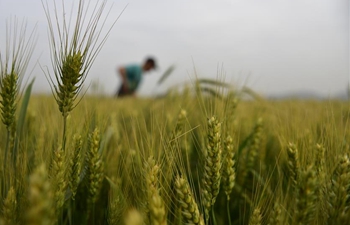
After harvesting almost 4 tonnes of wheat in June, Liu, a peasant living in Gaotai village of Funan County, is preparing for the coming maize sowing.
Previously, straw-burning was a main source of pollution in rural China,
"We could hardly breathe during the straw-burning season, it also damaged the environment," Liu recalled.
But that is no longer a concern for locals as straw is now put to good use.
"Now, about 500 kg of top quality straw from my land will be made into handicrafts, while the rest will be sent to feed mills," Liu said.
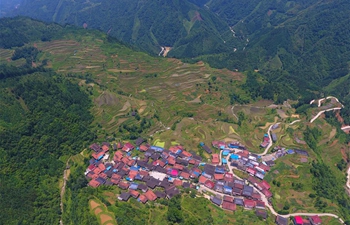
The Yangtze-Huaihe River basin, where Liu's land is located, is China's main agricultural region. Traditionally, Chinese farmers tend to burn the straw after harvests to clear the land, which causes heavy pollution.
In Funan alone, about 1.2 million tonnes of straw are produced every year, according to Qian Dajun, an official with the local agricultural department.
"Besides corn and wheat straw, we also have straw from vegetables and soybeans," Qian said.
Funan is famous for delicate wickerwork. The 500-year old craft was enlisted as a national intangible cultural heritage in 2011. Skilled craftsmen traditionally use local willow as the raw material, but now they have turned to straw.
Xu Zhihe, manager of the Funan-based Sanhe crafts company, said about 5 percent of the company's products are now made from straw.
Last year, Xu began using hot press technology to make children's furniture from crushed straw.
"The straw furniture has no formaldehyde, which is perfect for kids," Xu said. The first 200 sets of tables and chairs received good market response, and Xu plans to store 20,000 tonnes of straws this year for further production.
Liu Youwei, from a local agricultural technology company, is also running around, searching for straw. "Corn and wheat straw are rich in water and sugar, they are very good feed ingredients," he said.
The first production line of Liu Youwei's company can process up to 150,000 tonnes of straw per annum. Next year, he will have another five production lines in operation.
"Good-quality straw can be made into artifacts and furniture, while low-quality ones can be turned into manure and be put back to the field," Liu Youwei said.
In addition, straw can also be used to generate power, cultivate mushrooms and extract cellulose.
Funan now has six companies with an annual straw consumption of over 100,000 tonnes, which means more than 90 percent of straw is now recycled.
The price of straw is rising year by year, reaching 350 yuan (about 55 U.S. dollars) per tonne, 10 percent higher than in previous years, which is far beyond Liu Weiquan's expectation.
"In the past, we burned the straw because it was useless, but now burning it is like burning money. It has become our golden goose," he said.