








"/>

中文字幕网伦射乱中文-超清中文乱码字幕在线观看-亚洲v国产v欧美v久久久久久-久久性网-手机在线成人av-成人六区-国产人与zoxxxx另类一一-青青草国产久久精品-蜜桃av久久久一区二区三区麻豆-成人av一区二区免费播放-在线视频麻豆-www爱爱-成人免费看片视频-性欧美老肥妇喷水-五月99久久婷婷国产综合亚洲-亚洲最色-各种含道具高h调教1v1男男-91丨porny丨国产-国产精品无码专区在线观看不卡-大香伊人

Feature: U.S. college students embrace Chinese culture through language learning

Source: Xinhua    2018-04-27 04:29:29

NEW YORK, April 26 (Xinhua) -- When Jacob Colman started learning Chinese two and a half years ago, he never thought he would one day compete in a Chinese proficiency competition and tell the audience how far language learning has led him to explore the beauty of Chinese painting.

"A few weeks into the class I realized that I really liked the tonality of it (Chinese) and character writing... Everything about it was really interesting," Colman recalled his first encounter with the Chinese language as a sophomore.

At that time he had studied Spanish for ten years and was really bad at it the whole time. His academic advisor forced him to learn Chinese when he thought he was actually unable to learn a foreign language. What happened next proved him wrong.

He traveled to China in the hope of learning Chinese in its natural environment. During the trip, he was amazed by Song Dynasty paintings displayed in the National Museum of China. As soon as he came back to the United States, Colman set up one-on-one class with one of his Chinese professors, meeting twice a week with the professor and studying Chinese paintings and history.

His favorite Chinese painting so far, as he told the audience, is Wang Ximeng's "A Thousand Miles of Rivers and Mountains," because it is able to take people to the rivers and mountains in their heart like other good arts do.

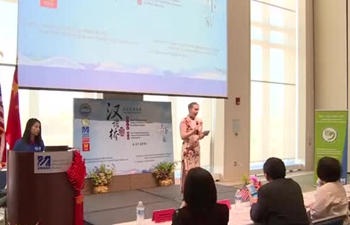
Colman entered the 17th "Chinese Bridge" -- Chinese Proficiency Competition -- for College Student East USA Preliminary held this April by the Confucius Institute at UMass Boston and New York Service Center for Chinese Study Fellows.

His speech about the comparison and contrast between Chinese and Western paintings won him the second place in advanced level and the best speaker of all. He was also selected as one of the six Confucius Institute Cultural Ambassadors who will take a ten-day trip to China in June.

Like Colman, Hye In Lee started learning Chinese when she knew nothing about Chinese art or literature. But the student from Binghamton University -- The State University of New York -- won rounds of applauds with her Peking Opera performance and eloquent speech.

"Chinese poetry touches my heart so deeply. Poems in English or Korean do not offer me such rich artistic experience," said Lee, who added that Chinese poetry allowed her to express feelings and sentiments that she otherwise would be unable to express.

She won the first place of advanced level in the competition. "I learned a lot in classes offered by the Confucius Institute of Chinese Opera at Binghamton University," Lee said.

As more and more people start leaning Chinese, the need for centers of leaning, like the Confucius Institute, is of greater demand.

As of the end of 2017, there were 525 Confucius institutes and 1,113 Confucius classrooms in 146 countries and regions across the world.

The Confucius Institute at UMass Boston, which held the competition this year, is the first of its kind in New England. It was established in 2006 and has become an important platform offering programs and services for Chinese language and cultural activities in the community.

Both Colman and Lee planned to continue learning Chinese language, but for different reasons.

A philosophy major, Colman will study in Tsinghua University, one of the most renowned Chinese universities, for one year. He plans to study ancient Chinese prose in order to better understand China's philosophical works.

Lee, on the other hand, felt speaking fluent Chinese would be an advantage when she looks for jobs in the future.

Editor: yan
Related News
Xinhuanet

Feature: U.S. college students embrace Chinese culture through language learning

Source: Xinhua 2018-04-27 04:29:29

NEW YORK, April 26 (Xinhua) -- When Jacob Colman started learning Chinese two and a half years ago, he never thought he would one day compete in a Chinese proficiency competition and tell the audience how far language learning has led him to explore the beauty of Chinese painting.

"A few weeks into the class I realized that I really liked the tonality of it (Chinese) and character writing... Everything about it was really interesting," Colman recalled his first encounter with the Chinese language as a sophomore.

At that time he had studied Spanish for ten years and was really bad at it the whole time. His academic advisor forced him to learn Chinese when he thought he was actually unable to learn a foreign language. What happened next proved him wrong.

He traveled to China in the hope of learning Chinese in its natural environment. During the trip, he was amazed by Song Dynasty paintings displayed in the National Museum of China. As soon as he came back to the United States, Colman set up one-on-one class with one of his Chinese professors, meeting twice a week with the professor and studying Chinese paintings and history.

His favorite Chinese painting so far, as he told the audience, is Wang Ximeng's "A Thousand Miles of Rivers and Mountains," because it is able to take people to the rivers and mountains in their heart like other good arts do.

Colman entered the 17th "Chinese Bridge" -- Chinese Proficiency Competition -- for College Student East USA Preliminary held this April by the Confucius Institute at UMass Boston and New York Service Center for Chinese Study Fellows.

His speech about the comparison and contrast between Chinese and Western paintings won him the second place in advanced level and the best speaker of all. He was also selected as one of the six Confucius Institute Cultural Ambassadors who will take a ten-day trip to China in June.

Like Colman, Hye In Lee started learning Chinese when she knew nothing about Chinese art or literature. But the student from Binghamton University -- The State University of New York -- won rounds of applauds with her Peking Opera performance and eloquent speech.

"Chinese poetry touches my heart so deeply. Poems in English or Korean do not offer me such rich artistic experience," said Lee, who added that Chinese poetry allowed her to express feelings and sentiments that she otherwise would be unable to express.

She won the first place of advanced level in the competition. "I learned a lot in classes offered by the Confucius Institute of Chinese Opera at Binghamton University," Lee said.

As more and more people start leaning Chinese, the need for centers of leaning, like the Confucius Institute, is of greater demand.

As of the end of 2017, there were 525 Confucius institutes and 1,113 Confucius classrooms in 146 countries and regions across the world.

The Confucius Institute at UMass Boston, which held the competition this year, is the first of its kind in New England. It was established in 2006 and has become an important platform offering programs and services for Chinese language and cultural activities in the community.

Both Colman and Lee planned to continue learning Chinese language, but for different reasons.

A philosophy major, Colman will study in Tsinghua University, one of the most renowned Chinese universities, for one year. He plans to study ancient Chinese prose in order to better understand China's philosophical works.

Lee, on the other hand, felt speaking fluent Chinese would be an advantage when she looks for jobs in the future.

[Editor: huaxia]
010020070750000000000000011105521371397881