中文字幕网伦射乱中文-超清中文乱码字幕在线观看-亚洲v国产v欧美v久久久久久-久久性网-手机在线成人av-成人六区-国产人与zoxxxx另类一一-青青草国产久久精品-蜜桃av久久久一区二区三区麻豆-成人av一区二区免费播放-在线视频麻豆-www爱爱-成人免费看片视频-性欧美老肥妇喷水-五月99久久婷婷国产综合亚洲-亚洲最色-各种含道具高h调教1v1男男-91丨porny丨国产-国产精品无码专区在线观看不卡-大香伊人

 
Scientists develop a two-step approach to starve lung tumor cells
                 Source: Xinhua | 2018-04-03 04:39:00 | Editor: huaxia

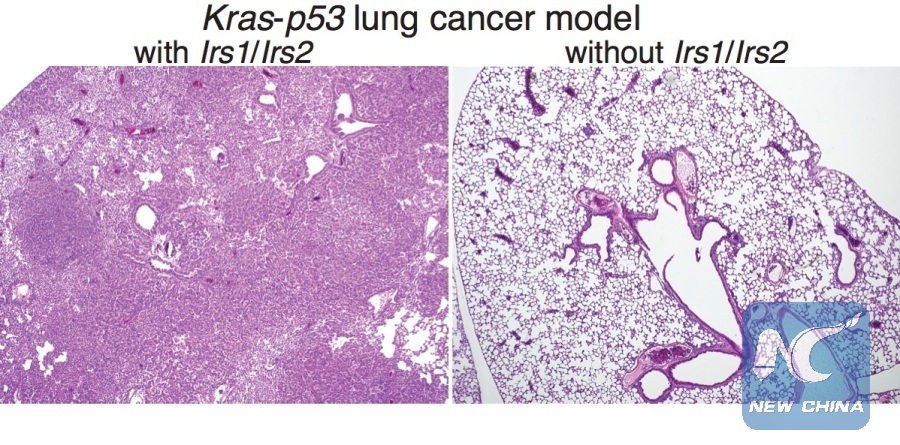
These two lung samples are from mice prone to develop Kras-mutant non-small-cell lung cancer. The lungs of mouse on the left are filled with tumors, as expected. The lung on the right, whose Kras-mutant cells have lost the Irs1/Irs2 genes, lacks the insulin/IGF-1 signaling needed for growth and is virtually devoid of tumors. (In a later stage, the tumors develop a workaround that enables them to start growing again.) (Credit: Clare (He) Xu, PhD, Boston Children's Hospital)

WASHINGTON, April 2 (Xinhua) -- American scientists developed a two-prolonged therapy with a combination of drugs that are already available clinically to starve the tumor cells to death.

The Boston Children's Hospital study, published on Monday in the Proceedings of the National Academy of Sciences, has shown that the non-small-cell lung cancer driven by an oncogene called KRAS can be treated after completely blocking IFG-1 signaling.

IGF-1 signaling is a pathway that influences the uptake and release of nutrients and ultimately cell growth, according to the researchers.

"Growth factors like IGF-1 tell cells that nutrients are around, so when you suppress their signaling, the tumor cells don't take up the amino acids," said Nada Kalaany, a researcher in Boston Children's Hospital and the paper's senior author.

Kalaany's team used two groups of mice with KRAS-driven lung cancer. The second group has been deleted with two key genes, known as Irs1 and Irs2, which encode so-called "adaptor" proteins that are necessary for insulin/IGF-1 signaling.

"Almost all animals in this lung cancer model typically die within 15 weeks of KRAS activation," said Kalaany. "But the ones that lost both Irs1 and Irs2 were completely fine, we saw almost no tumors at 10 to 15 weeks."

Metabolic profiling revealed that tumor cells lacking Irs1/2 had significantly lower levels of essential amino acids, the building blocks of protein. Yet, outside the cells, amino acids were plentiful.

But that's not the whole story. When tumor cells "think" that they are starved, according to Kalaany, they can compensate for this and break down their own proteins to generate amino acids.

The researchers tried to inhibit the protein breakdown with existing drugs, such as chloroquine, which inhibits autophagy, and bortezomib, a proteasome inhibitor that is used to treat multiple myeloma.

When Kalaany's team injected human tumor cells lacking Irs1/2 into mice, tumors didn't grow as well. When they added inhibitors of protein breakdown, growth was almost completely suppressed.

"Our work tries to identify metabolic dependencies and vulnerabilities in tumors," said Kalaany.

However, Kalaany warned that, though both types of drugs, as well as IGF-1 inhibitors, are well tolerated, care would need to be taken in dosing any combination therapy to avoid toxicities.

Back to Top Close
Xinhuanet

Scientists develop a two-step approach to starve lung tumor cells

Source: Xinhua 2018-04-03 04:39:00

These two lung samples are from mice prone to develop Kras-mutant non-small-cell lung cancer. The lungs of mouse on the left are filled with tumors, as expected. The lung on the right, whose Kras-mutant cells have lost the Irs1/Irs2 genes, lacks the insulin/IGF-1 signaling needed for growth and is virtually devoid of tumors. (In a later stage, the tumors develop a workaround that enables them to start growing again.) (Credit: Clare (He) Xu, PhD, Boston Children's Hospital)

WASHINGTON, April 2 (Xinhua) -- American scientists developed a two-prolonged therapy with a combination of drugs that are already available clinically to starve the tumor cells to death.

The Boston Children's Hospital study, published on Monday in the Proceedings of the National Academy of Sciences, has shown that the non-small-cell lung cancer driven by an oncogene called KRAS can be treated after completely blocking IFG-1 signaling.

IGF-1 signaling is a pathway that influences the uptake and release of nutrients and ultimately cell growth, according to the researchers.

"Growth factors like IGF-1 tell cells that nutrients are around, so when you suppress their signaling, the tumor cells don't take up the amino acids," said Nada Kalaany, a researcher in Boston Children's Hospital and the paper's senior author.

Kalaany's team used two groups of mice with KRAS-driven lung cancer. The second group has been deleted with two key genes, known as Irs1 and Irs2, which encode so-called "adaptor" proteins that are necessary for insulin/IGF-1 signaling.

"Almost all animals in this lung cancer model typically die within 15 weeks of KRAS activation," said Kalaany. "But the ones that lost both Irs1 and Irs2 were completely fine, we saw almost no tumors at 10 to 15 weeks."

Metabolic profiling revealed that tumor cells lacking Irs1/2 had significantly lower levels of essential amino acids, the building blocks of protein. Yet, outside the cells, amino acids were plentiful.

But that's not the whole story. When tumor cells "think" that they are starved, according to Kalaany, they can compensate for this and break down their own proteins to generate amino acids.

The researchers tried to inhibit the protein breakdown with existing drugs, such as chloroquine, which inhibits autophagy, and bortezomib, a proteasome inhibitor that is used to treat multiple myeloma.

When Kalaany's team injected human tumor cells lacking Irs1/2 into mice, tumors didn't grow as well. When they added inhibitors of protein breakdown, growth was almost completely suppressed.

"Our work tries to identify metabolic dependencies and vulnerabilities in tumors," said Kalaany.

However, Kalaany warned that, though both types of drugs, as well as IGF-1 inhibitors, are well tolerated, care would need to be taken in dosing any combination therapy to avoid toxicities.

010020070750000000000000011105091370837361