中文字幕网伦射乱中文-超清中文乱码字幕在线观看-亚洲v国产v欧美v久久久久久-久久性网-手机在线成人av-成人六区-国产人与zoxxxx另类一一-青青草国产久久精品-蜜桃av久久久一区二区三区麻豆-成人av一区二区免费播放-在线视频麻豆-www爱爱-成人免费看片视频-性欧美老肥妇喷水-五月99久久婷婷国产综合亚洲-亚洲最色-各种含道具高h调教1v1男男-91丨porny丨国产-国产精品无码专区在线观看不卡-大香伊人

 
Global scientists give accolades to Hawking's accomplishments
                 Source: Xinhua | 2018-03-15 01:21:11 | Editor: huaxia

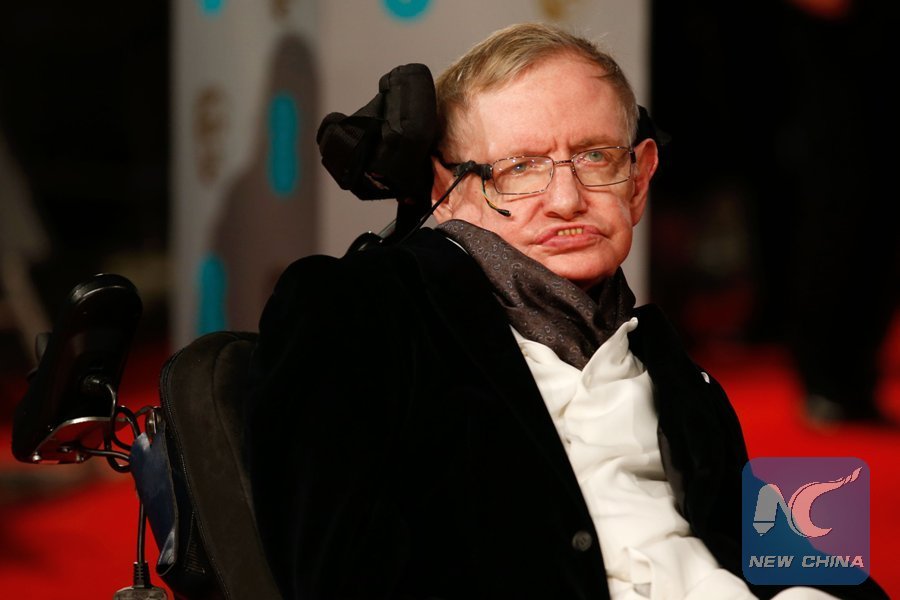
File photo taken on Feb. 8, 2015 shows British scientist Stephen Hawking arriving for the BAFTA British Academy Film Awards at the Royal Opera House in London. (Xinhua/AFP)

WASHINGTON, March 14 (Xinhua) -- Scientists around the world have mourned the passing of and given high accolades to Stephen Hawking, the British physicist who revealed some secrets of the origin of the universe in his rather difficult lifetime stricken by deadly disease.

American space agency NASA praised Hawking who died in the early hours of Wednesday "a renowned physicist and ambassador of science," whose "theories unlocked a universe of possibilities that we and the world are exploring."
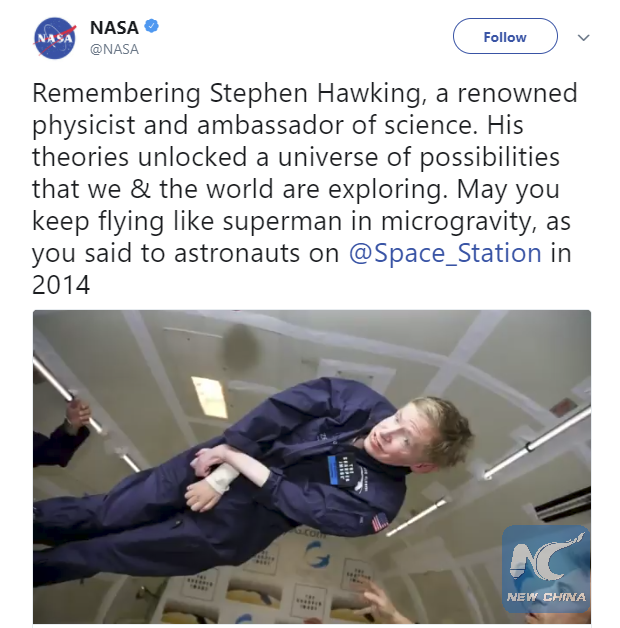
NASA tweets on the passing of Stephen Hawking.

He "showed us there are no limits to achieving our dreams," European Space Agency said in its twitter account, praising the man who suffered amyotrophic lateral sclerosis and lost his ability to write down math equations, but worked with incredible determination to make great accomplishments in cosmology.
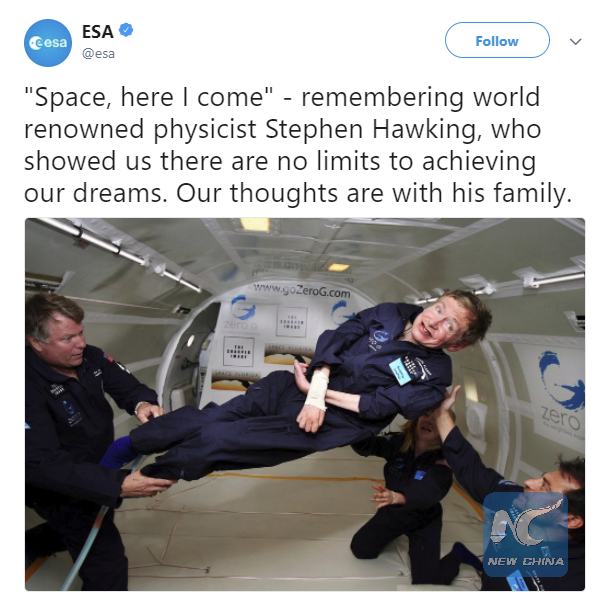
European Space Agency tweets on the passing of Stephen Hawking.

Christopher Shaw, a neuroscientist at King's College London called Hawking "an outliers outlier, both in terms of his extraordinary contribution to science and the time he survived with motor neuron disease."

"Stephen Hawking overcame unimaginable challenges to become one of the most influential and renowned scientists of our time. His life is a testament to the power of human creativity and imagination," said Venki Ramakrishnan, President of Britain's Royal Society.

Hawking, known for his work with black holes and relativity, had sought "new links between the very large (the cosmos) and the very small (atoms and quantum theory) and to gain deeper insights into the very beginning of our universe," according to Hawking's colleague Martin Rees, an astronomer with the University of Cambridge.

Hawking predicted that black holes would not be completely black, but would radiate in a characteristic way. His most important scientific legacy is his idea that "black holes slowly dissolve like aspirin in a glass of water," in the words of Lisa Harvey-Smith, an Australian astronomer.

"It is still the focus of theoretical interest, a topic of debate and controversy more than 40 years after his discovery," Rees said.

Hawking is also the author of popular science book "A Brief History of Time."

Flowers are seen at the gate of Gonville and Caius College at the University of Cambridge following the death of Professor Stephen Hawking, in Cambridge, Britain, on March 14, 2018. (Xinhua/Isabel Infantes)

"He was a true genius who had a great admiration of and connection to the public. Most people, when he published A Brief History of Time, would have thought a book about physics would not sell. But Stephen knew people would want to read it and it turned out they did," said Katherine Mathieson, Chief Executive of the British Science Association.

Michio Kaku, American theoretical physicist called Hawking the "rock star of science."

Rees said Stephen was "far from being the archetype unworldy or nerdish scientist. His personality remained amazingly unwarped by his frustrations and handicaps."

Satya Nadella, Microsoft's CEO, said that "we lost a great one today," who will be remembered for "his spirit and unbounded pursuit to gain a complete understanding of the universe, despite the obstacle he faced."

"Stephen Hawking was a great physicist, a great public communicator, and a great icon for science and rationalism throughout the world," according to Paul Nurse, Chief Executive and Director of the Francis Crick Institute.

Back to Top Close
Xinhuanet

Global scientists give accolades to Hawking's accomplishments

Source: Xinhua 2018-03-15 01:21:11

File photo taken on Feb. 8, 2015 shows British scientist Stephen Hawking arriving for the BAFTA British Academy Film Awards at the Royal Opera House in London. (Xinhua/AFP)

WASHINGTON, March 14 (Xinhua) -- Scientists around the world have mourned the passing of and given high accolades to Stephen Hawking, the British physicist who revealed some secrets of the origin of the universe in his rather difficult lifetime stricken by deadly disease.

American space agency NASA praised Hawking who died in the early hours of Wednesday "a renowned physicist and ambassador of science," whose "theories unlocked a universe of possibilities that we and the world are exploring."

NASA tweets on the passing of Stephen Hawking.

He "showed us there are no limits to achieving our dreams," European Space Agency said in its twitter account, praising the man who suffered amyotrophic lateral sclerosis and lost his ability to write down math equations, but worked with incredible determination to make great accomplishments in cosmology.

European Space Agency tweets on the passing of Stephen Hawking.

Christopher Shaw, a neuroscientist at King's College London called Hawking "an outliers outlier, both in terms of his extraordinary contribution to science and the time he survived with motor neuron disease."

"Stephen Hawking overcame unimaginable challenges to become one of the most influential and renowned scientists of our time. His life is a testament to the power of human creativity and imagination," said Venki Ramakrishnan, President of Britain's Royal Society.

Hawking, known for his work with black holes and relativity, had sought "new links between the very large (the cosmos) and the very small (atoms and quantum theory) and to gain deeper insights into the very beginning of our universe," according to Hawking's colleague Martin Rees, an astronomer with the University of Cambridge.

Hawking predicted that black holes would not be completely black, but would radiate in a characteristic way. His most important scientific legacy is his idea that "black holes slowly dissolve like aspirin in a glass of water," in the words of Lisa Harvey-Smith, an Australian astronomer.

"It is still the focus of theoretical interest, a topic of debate and controversy more than 40 years after his discovery," Rees said.

Hawking is also the author of popular science book "A Brief History of Time."

Flowers are seen at the gate of Gonville and Caius College at the University of Cambridge following the death of Professor Stephen Hawking, in Cambridge, Britain, on March 14, 2018. (Xinhua/Isabel Infantes)

"He was a true genius who had a great admiration of and connection to the public. Most people, when he published A Brief History of Time, would have thought a book about physics would not sell. But Stephen knew people would want to read it and it turned out they did," said Katherine Mathieson, Chief Executive of the British Science Association.

Michio Kaku, American theoretical physicist called Hawking the "rock star of science."

Rees said Stephen was "far from being the archetype unworldy or nerdish scientist. His personality remained amazingly unwarped by his frustrations and handicaps."

Satya Nadella, Microsoft's CEO, said that "we lost a great one today," who will be remembered for "his spirit and unbounded pursuit to gain a complete understanding of the universe, despite the obstacle he faced."

"Stephen Hawking was a great physicist, a great public communicator, and a great icon for science and rationalism throughout the world," according to Paul Nurse, Chief Executive and Director of the Francis Crick Institute.

010020070750000000000000011100001370393751